
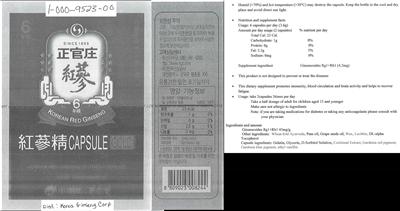
| Total Calories | 25 cal | |
| Carbohydrates | 1 g | 0% |
| Protein | 0 g | 0% |
| Fat | 2.5 g | 5% |
| Sodium | 0 mg | 0% |
| Ginsenosides Rg1+Rb1 | 4.2 mg |
Other ingredients: Wheat-fold, Palm Oil, Grape seeds oil, Wax, Lecithin, DL-Alpha-Tocopherol, Capsule ingredients:
% Daily Values for: Adults and children 4 or more years of age.
Where this label comes from
An original label of the NIH's Dietary Supplement Label Database, entered there on 1 October 2012, shown here as it was entered. The NIH's record
General information
- Product name
- Korean Red Ginseng
- Brand
- Korea Ginseng Corp.
- Barcode (UPC)
- 8 809023 008244
- Net contents
- 100 Capsule(s); 60 g
- Market status
- On market
- DSLD ID
- 13550
Classification
Label statements
Storage: - Humid (>70%) and hot temperature (>30(0)C) may destroy the capsule. Keep the bottle in the cool and dry place and avoid direct sun light.
Directions: Usage: 6 capsules per day (3.6g)
Directions: - Usage: take 2capsules 3times per day take a half dosage of adult for children aged 15 and younger
Precautions: Allergies: Make sure not allergic to ingredients
Formula: Contains: Ingredients and amount Ginsenosides Rg1+Rb1 45mg/g
Precautions: Pregnant or Nursing or Prescription Medications: Note: if you are taking medications for diabetes or taking any anticoagulants please consult with your physician.
Brand information
Dist: Korea Ginseng Corp.
More labels from Korea Ginseng Corp.
Labels only: each label is shown as printed on the bottle, with no grades, rankings or advice. A label in this database is not an endorsement of the product. Read the label on the bottle you buy: makers change their formulas. Reverse Age Lab is not affiliated with, or endorsed by, the National Institutes of Health or its Office of Dietary Supplements. The original labels come from the NIH’s public-domain data; the labels since are read by us. Search the Dietary Supplement Label Database.