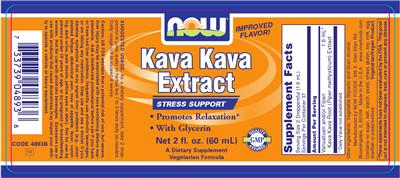
| Vanuatuan and/or Fijian Kava Kava root (Piper methysticum) extract | 1.6 mL | † |
Other ingredients: Vegetable Glycerin, Grain Alcohol
% Daily Values for: Adults and children 4 or more years of age.
Where this label comes from
An original label of the NIH's Dietary Supplement Label Database, entered there on 25 October 2012, shown here as it was entered. The NIH's record
General information
- Product name
- Kava Kava Extract
- Brand
- NOW
- Barcode (UPC)
- 7 33739 04893 6
- Net contents
- 2 fl. Oz.; 60 mL
- Market status
- Off market
- DSLD ID
- 14126
Classification
Label statements
Formulation: Does NOT Contain: Contains no sugar, salt, starch, yeast, wheat, gluten, soy, milk, egg, shellfish or preservatives.
Formula: Contains: • With Glycerin
FDA Statement of Identity: A Dietary Supplement
Precautions: All Other: Caution: US FDA advises that a potential risk of rare, but severe, liver injury may be associated with kava-containing dietary supplements. Ask a healthcare professional before use if you have or have had liver problems, frequently use alcoholic beverages, or are taking any medication. Stop use and see a doctor if you develop symptoms that may signal liver problems (e.g., unexplained fatigue, abdominal pain, loss of appetite, fever, vomiting, dark urine, pale stools, yellow eyes or skin).
Precautions: Pregnant or Nursing or Prescription Medications: Not for use by persons under 18 years of age, or by pregnant or breastfeeding women. Not for use with alcoholic beverages. Excessive use or use with products that cause drowsiness may impair your ability to operate a vehicle or heavy equipment.
Brand information
Manufactured by: NOW FOODS, Bloomingdale, IL
More labels from NOW
Labels only: each label is shown as printed on the bottle, with no grades, rankings or advice. A label in this database is not an endorsement of the product. Read the label on the bottle you buy: makers change their formulas. Reverse Age Lab is not affiliated with, or endorsed by, the National Institutes of Health or its Office of Dietary Supplements. The original labels come from the NIH’s public-domain data; the labels since are read by us. Search the Dietary Supplement Label Database.