
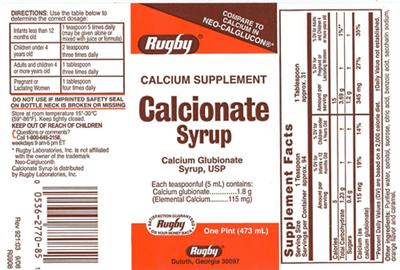
| Calories | 5 {Calories} | |
| Total Carbohydrates | 1.23 g | † |
| Sugar | 0.4 g | † |
| Calcium (as as calcium glubionate)Calcium (Form: as calcium glubionate) | 115 mg | 14% |
Other ingredients: purified Water, Sorbitol, Sucrose, Citric Acid, Benzoic Acid, Saccharin Sodium, Orange flavor, Caramel
% Daily Values for: Adults and children 4 or more years of age; Infants; Children less than 4 years of age; Pregnant and Lactating.
Where this label comes from
An original label of the NIH's Dietary Supplement Label Database, entered there on 25 February 2013, shown here as it was entered. The NIH's record
General information
- Product name
- Calcionate Syrup
- Brand
- Rugby
- Barcode (UPC)
- 0 0536-2770-85 1
- Net contents
- 1 PT; 473 mL
- Market status
- On market
- DSLD ID
- 14443
Classification
Label statements
Directions: DIRECTIONS: Use the table below to determine the correct dosage: Infants less that 12 months old 1 teaspoon 5 times daily (may be given alone or mixed with juice or formula) Children under 4 years old 2 teaspoons three times daily Adults and children 4 or more years old 1 tablespoon three times daily Pregnant or Lactating Women 1 tablespoon four times daily
FDA Statement of Identity: CALCIUM SUPPLEMENT
Formula: Contains: Each teaspoonful (5 mL) contains: Calcium glubionate..........1.8 g (Elemental Calcium........115mg)
Precautions: All Other: DO NOT USE IF IMPRINTED SAFETY SEAL ON BOTTLE NECK IS BROKEN OR MISSING
Storage: Store at room temperature 15(0)-30(0)C (59(0)-86(0)F). Keep tightly closed.
Brand information
Calcionate Syrup is distributed by: Rugby Laboratories, Inc.
Manufacturer: Rugby(R), Duluth, Georgia, 30097
More labels from Rugby
Labels only: each label is shown as printed on the bottle, with no grades, rankings or advice. A label in this database is not an endorsement of the product. Read the label on the bottle you buy: makers change their formulas. Reverse Age Lab is not affiliated with, or endorsed by, the National Institutes of Health or its Office of Dietary Supplements. The original labels come from the NIH’s public-domain data; the labels since are read by us. Search the Dietary Supplement Label Database.