
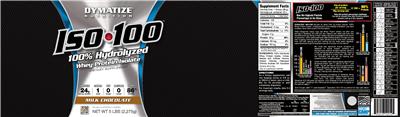
| Calories | 106 {Calories} | |
| Total Fat | 0 g | 0% |
| Cholesterol | 0 mg | 0% |
| Total Carbohydrates | 1 g | <1% |
| Sugar | 0 g | |
| Protein | 24 g | 48% |
| Calcium | 60 mg | 6% |
| Sodium | 50 mg | 2% |
Other ingredients: 100% Hydrolyzed Whey Protein Isolate, Cocoa, Natural and Artificial flavors, Sodium Chloride, Potassium Chloride, Soybean Oil, Sucralose
% Daily Values for: Adults and children 4 or more years of age.
Where this label comes from
An original label of the NIH's Dietary Supplement Label Database, entered there on 25 October 2012, shown here as it was entered. The NIH's record
General information
- Product name
- Iso-100 Milk Chocolate
- Brand
- Dymatize Nutrition
- Barcode (UPC)
- 7 05016 10012 5
- Net contents
- 5 lbs; 2275 g
- Market status
- Off market
- DSLD ID
- 14674
Classification
- Supplement form
- Powder
- Product type
- Other Combinations
- Claim types on the label
- Nutrient, All Other, Structure/Function
- Intended for
- Adult (18 - 50 Years), Gluten Free
Label statements
FDA Statement of Identity: DIETARY SUPPLEMENT
Formula: Contains: PROTEIN 24g PER 28g SERVING CARBS 1 GRAM FAT 0 GRAMS LACTOSE 0 GRAMS RATIO 86% PROTEIN
Directions: DIRECTIONS: As a dietary supplement, add one heaping scoop to 4-8 oz. or 350ml of water, juice or milk. Mix for 15 seconds or until completely dispersed. For maximum results, take 2-3 servings daily.
Formula: Contains: Nutritional Value per (28g/100g) 28g 100g Calories 443kJ/106kcal 1582kJ/379kcal Protein 24 grams 85.4 grams Carbohydrates 1 gram 5 grams Fat 0 gram 1 gram
Brand information
Manufactured & Distributed by: Dymatize Enterprises, LLC, Dallas, TX
More labels from Dymatize Nutrition
Labels only: each label is shown as printed on the bottle, with no grades, rankings or advice. A label in this database is not an endorsement of the product. Read the label on the bottle you buy: makers change their formulas. Reverse Age Lab is not affiliated with, or endorsed by, the National Institutes of Health or its Office of Dietary Supplements. The original labels come from the NIH’s public-domain data; the labels since are read by us. Search the Dietary Supplement Label Database.