
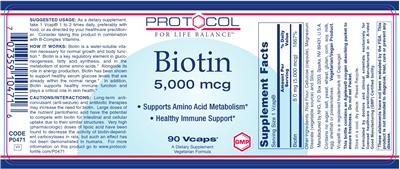
| BiotinBiotin Note: 5,000 mcg | 5 mg | 1,667% |
Other ingredients: Rice Flour, Cellulose, Magnesium Stearate, Silica
% Daily Values for: Adults and children 4 or more years of age.
Where this label comes from
An original label of the NIH's Dietary Supplement Label Database, entered there on 21 November 2012, shown here as it was entered. The NIH's record
General information
- Product name
- Biotin 5,000 mcg
- Brand
- Protocol For Life Balance
- Barcode (UPC)
- 7 07359 10471 6
- Net contents
- 90 Vcap(s)(R)
- Market status
- Off market
- DSLD ID
- 14964
Classification
Label statements
FDA Statement of Identity: A Dietary Supplement
Precautions: All Other: This bottle contains an Ageless(R) oxygen absorbing packet to ensure freshness. Do not eat Packet.
Storage: Store in a cool, dry place.
Directions: SUGGESTED USAGE: As a dietary supplement, take 1 Vcap(R) 1 to 2 times daily, preferably with food, or as directed by your healthcare practitioner. Consider taking this product in combination with B-Complex Vitamins.
Precautions: Pregnant or Nursing or Prescription Medications: CAUTIONS/INTERACTIONS: Long-term anticonvulsant (anti-seizure) and antibiotic therapies may increase the need for biotin. Large doses of the nutrient pantothenic acid have the potential to compete with biotin for intestinal and cellular uptake due to their similar structures. Very high (pharmacologic) doses of lipoic acid have been found to decrease the activity of biotin-dependent carboxylases in rats, but such an effect has not been demonstrated in humans.
Formulation: Does NOT Contain: Contains no sugar, salt, yeast, wheat, gluten, corn, soy, milk, egg, shellfish or preservatives.
Brand information
Manufactured by: NHG, Sparks, NV, U.S.A.
More labels from Protocol For Life Balance
Labels only: each label is shown as printed on the bottle, with no grades, rankings or advice. A label in this database is not an endorsement of the product. Read the label on the bottle you buy: makers change their formulas. Reverse Age Lab is not affiliated with, or endorsed by, the National Institutes of Health or its Office of Dietary Supplements. The original labels come from the NIH’s public-domain data; the labels since are read by us. Search the Dietary Supplement Label Database.