
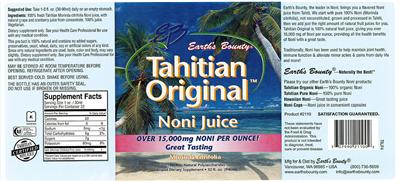
| Calories | 20 {Calories} | |
| Calories from Fat | 0 {Calories} | 0% |
| Sodium | 5 mg | <1% |
| Total Carbohydrates | 5 g | 2% |
| Sugar | 7 g | |
| Potassium | 60 mg | 3% |
| Noni (Morinda citrifolia) fruit juice | 15,000 mg | † |
Other ingredients: 100% fresh Tahitian Morinda citrifolia Noni juice
% Daily Values for: Adults and children 4 or more years of age.
Where this label comes from
An original label of the NIH's Dietary Supplement Label Database, entered there on 21 December 2012, shown here as it was entered. The NIH's record
General information
- Product name
- Tahitian Original Noni Juice
- Brand
- EB Earth's Bounty
- Barcode (UPC)
- 7 07990 21100 2
- Net contents
- 32 fl. Oz.; 946 mL
- Market status
- Off market
- DSLD ID
- 15107
Classification
Label statements
Precautions: All Other: See your Health Care Professional for use with any medical condition.
Formula: Contains: OVER 15,000 mg NONI PER OUNCE!
Formula: Contains: Morinda citrifolia
Directions: Suggested use: Take 1-3 fl. oz. (30-90ml) daily on an empty stomach.
Formulation: Does NOT Contain: This product is 100% natural and contains no added sugars, preservatives, yeast, wheat, dairy, soy or artificial colors of any kind.
Storage: MAY BE STORED AT ROOM TEMPERATURE BEFORE OPENING. REFRIGERATE AFTER OPENING.
Directions: BEST SERVED COLD. SHAKE BEFORE USING.
Precautions: All Other: THIS BOTTLE HAS AN OUTER SAFETY SEAL. DO NOT USE IF BROKEN OR MISSING.
FDA Statement of Identity: Liquid Dietary Supplement
Formula: Contains: High in Natural Polysaccharides
Formula: Contains: 100% juice.
Brand information
Mfg for & Dist by: Earth's Bounty(R), Vancouver, WA, USA
More labels from EB Earth's Bounty
Labels only: each label is shown as printed on the bottle, with no grades, rankings or advice. A label in this database is not an endorsement of the product. Read the label on the bottle you buy: makers change their formulas. Reverse Age Lab is not affiliated with, or endorsed by, the National Institutes of Health or its Office of Dietary Supplements. The original labels come from the NIH’s public-domain data; the labels since are read by us. Search the Dietary Supplement Label Database.