
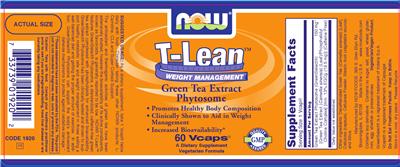
| Green Tea extract phytosome (as min. EGCg, Green Tea extract, Phosphatidyl Choline Complex)Green Tea extract phytosome (Form: Green Tea extract PlantPart: leaf Genus: Camellia Species: sinensis, Phosphatidyl Choline Complex, min. 13% EGCg Note: 19.5 mg) (Alt. Name: GreenSelect(R)) Note: Caffeine-Free | 150 mg | † |
Other ingredients: decaffeinated Green Tea, Cellulose, Cellulose powder, Stearic Acid, Silica
% Daily Values for: Adults and children 4 or more years of age.
Where this label comes from
An original label of the NIH's Dietary Supplement Label Database, entered there on 21 November 2012, shown here as it was entered. The NIH's record
General information
- Product name
- T-Lean Green Tea Extract Phytosome
- Brand
- NOW
- Barcode (UPC)
- 7 33739 01920 2
- Net contents
- 60 Vcap(s)(R)
- Market status
- Off market
- DSLD ID
- 15215
Classification
Label statements
FDA Statement of Identity: A Dietary Supplement
Precautions: All Other: Caution: Take with food.
Precautions: Pregnant or Nursing or Prescription Medications: Consult your healthcare practitioner prior to use if you are pregnant/lactating, have liver disease or are currently taking any medications.
Formula: Contains: Contains no sugar, salt, yeast, wheat, gluten, milk, egg, shellfish or preservatives.
Precautions: All Other: Do Not Eat Freshness Packet. Keep in Bottle.
Directions: SUGGESTED USAGE: As a dietary supplement, take 1 Vcap(R) twice daily with food. Consider taking these other NOW(R) products: LCarnitine, CLA and Super Cortisol Support.
Formula: Contains: Contains soy derivative.
Storage: Store in a cool, dry place.
Brand information
Manufactured by: NOW FOODS, Bloomingdale, IL
More labels from NOW
Labels only: each label is shown as printed on the bottle, with no grades, rankings or advice. A label in this database is not an endorsement of the product. Read the label on the bottle you buy: makers change their formulas. Reverse Age Lab is not affiliated with, or endorsed by, the National Institutes of Health or its Office of Dietary Supplements. The original labels come from the NIH’s public-domain data; the labels since are read by us. Search the Dietary Supplement Label Database.