
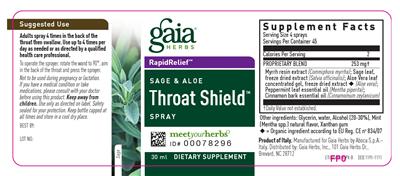
| CaloriesCalories Note: per serving | 2 {Calories} | |
| PROPRIETARY BLEND (as Aloe Vera leaf concentrated gel, Cinnamon bark essential oil, Myrrh resin extract, Peppermint Leaf Essential Oil, Sage leaf) | 253 mg | † |
Other ingredients: Glycerin, Water, Alcohol, Mint (Mentha spp.) natural flavor, Xanthan Gum
% Daily Values for: Adults and children 4 or more years of age.
Where this label comes from
An original label of the NIH's Dietary Supplement Label Database, entered there on 21 December 2012, shown here as it was entered. The NIH's record
General information
- Product name
- Sage & Aloe Throat Shield Spray
- Brand
- Gaia Herbs RapidRelief
- Barcode (UPC)
- Not printed
- Net contents
- 30 mL
- Market status
- Off market
- DSLD ID
- 16462
Classification
Label statements
Precautions: Pregnant or Nursing or Prescription Medications: Not to be used during pregnancy or lactation. If you have a medical condition or take medications, please consult with your doctor before using this product.
Precautions: Children: Keep away from children.
Precautions: All Other: Use only as directed on label. Safety sealed for your protection.
Formula: Contains: Sage
FDA Statement of Identity: DIETARY SUPPLEMENT
Directions: Suggested Use Adults spray 4 times in the back of the throat then swallow. Use up to 4 times per day as needed or as directed by a qualified health care professional. To operate the sprayer, rotate the wand to 90(0), aim in the back of the throat and press the sprayer.
Storage: Keep bottle capped at all times and store in a cool dry place.
Brand information
Manufactured for: Gaia Herbs by Aboca S.p.A. - Italy.
Distributed by: Gaia Herbs, Inc., Brevard, NC
More labels from Gaia Herbs RapidRelief
Labels only: each label is shown as printed on the bottle, with no grades, rankings or advice. A label in this database is not an endorsement of the product. Read the label on the bottle you buy: makers change their formulas. Reverse Age Lab is not affiliated with, or endorsed by, the National Institutes of Health or its Office of Dietary Supplements. The original labels come from the NIH’s public-domain data; the labels since are read by us. Search the Dietary Supplement Label Database.