
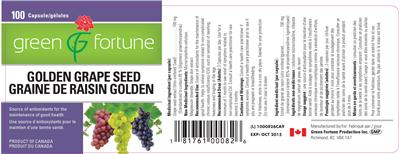
| Grape seed extract (as Standardized to contain Oligomeric proanthocyanidins)Grape seed extract (Form: Standardized to contain 85% Oligomeric proanthocyanidins) PlantPart: Seed Genus: Vitis Species: vinifera | 100 mg |
Other ingredients: Microcrystalline Cellulose, Magnesium Stearate, Grape skin extract
% Daily Values for: Adults and children 4 or more years of age.
Where this label comes from
An original label of the NIH's Dietary Supplement Label Database, entered there on 21 December 2012, shown here as it was entered. The NIH's record
General information
- Product name
- Grape Seed
- Brand
- Green Fortune
- Barcode (UPC)
- 1 81761 00082 6
- Net contents
- 100 Capsule(s)
- Market status
- Off market
- DSLD ID
- 16784
Classification
Label statements
Precautions: All Other: Cautions and Warnings: Consult a health care practitioner if symptoms worsen.
Precautions: Pregnant or Nursing or Prescription Medications: Consult a health care practitioner prior to use if you are pregnant or breastfeeding.
Directions: Recommended Use: Source of antioxidants for the maintenance of good health. Helps to relieve symptoms related to non-complicated chronic venous insufficiency (CVI), such as sensation of swelling, heaviness and tingling of the legs Recommended Dose (Adults): 3 Capsules per day. Use for a minimum of 1 month to see relief of symptoms related to non-complicated CVI. Consult a health care practitioner for use beyond 3 months.
Storage: For freshness, store in a cool, dry place.
Precautions: All Other: Do not use if seal is broken.
Brand information
Manufactured by/for: Green Fortune Production Inc., Richmond, BC
More labels from Green Fortune
Labels only: each label is shown as printed on the bottle, with no grades, rankings or advice. A label in this database is not an endorsement of the product. Read the label on the bottle you buy: makers change their formulas. Reverse Age Lab is not affiliated with, or endorsed by, the National Institutes of Health or its Office of Dietary Supplements. The original labels come from the NIH’s public-domain data; the labels since are read by us. Search the Dietary Supplement Label Database.