
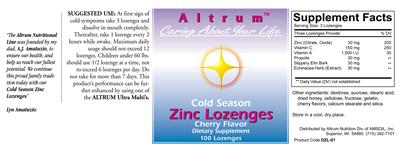
| Zinc (as Zinc Citrate, Zinc Oxide) | 30 mg | 200% |
| Vitamin C | 150 mg | 250% |
| Vitamin A | 1,500 IU | 30% |
| Propolis | 30 mg | † |
| Slippery Elm | 30 mg | † |
| Echinacea HerbEchinacea Herb PlantPart: Herb Note: Extract | 30 mg | † |
Other ingredients: Dextrose, Sucrose, Stearic Acid, dried honey, Cellulose, Fructose, Gelatin, Cherry flavors, Calcium Stearate, Silica
% Daily Values for: Adults and children 4 or more years of age.
Where this label comes from
An original label of the NIH's Dietary Supplement Label Database, entered there on 25 February 2013, shown here as it was entered. The NIH's record
General information
- Product name
- Cold Season Zinc Lozenges Cherry Flavor
- Brand
- Altrum
- Barcode (UPC)
- Not printed
- Net contents
- 100 Lozenge(s)
- Market status
- On market
- DSLD ID
- 17215
Classification
- Supplement form
- Lozenge
- Product type
- Botanical with Nutrients
- Claim types on the label
- All Other
- Intended for
- Children 4 or More Years of Age, Adult (18 - 50 Years)
Label statements
Directions: SUGGESTED USE: At first sign of cold symptoms take 3 lozenges and dissolve in mouth completely. Thereafter, take 1 lozenge every 2 hours while awake. Maximum daily usage should not exceed 12 lozenges. Children under 60 lbs. should use 1/2 lozenge at a time, not to exceed 6 lozenges per day. Do not take for more than 7 days. This product's performance can be further enhanced by using one of the ALTRUM Ultra Multi's.
FDA Statement of Identity: Dietary Supplement
Storage: Store in a cool, dry place.
Brand information
Distributed by: Altrum Nutrition Div. of AMSOIL, Inc., Superior, WI
More labels from Altrum
Labels only: each label is shown as printed on the bottle, with no grades, rankings or advice. A label in this database is not an endorsement of the product. Read the label on the bottle you buy: makers change their formulas. Reverse Age Lab is not affiliated with, or endorsed by, the National Institutes of Health or its Office of Dietary Supplements. The original labels come from the NIH’s public-domain data; the labels since are read by us. Search the Dietary Supplement Label Database.