
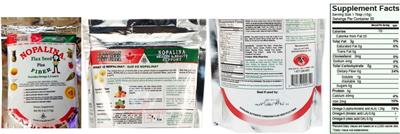
| Calories | 70 | |
| Calories from Fat | 25 | |
| Total Fat | 3 g | 5% |
| Saturated Fat | 0 g | 0% |
| Trans Fat | 0 g | |
| Cholesterol | 0 mg | 0% |
| Sodium | 4 mg | 0% |
| Total Carbohydrates | 8 g | 3% |
| Dietary Fiber | 6 g | 24% |
| Soluble Fiber | 1 g | |
| Insoluble Fiber | 5 g | |
| Sugar | 0 g | |
| Protein | 3 g | |
| Calcium | 49 mg | 4% |
| Iron | 2 mg | 10% |
| Alpha-Linolenic AcidOmega-3 (Form: Alpha-Linolenic Acid (Alt. Name: ALA)) | 1.25 g | 78% |
| Linoleic AcidOmega-6 (Form: Linoleic Acid (Alt. Name: LA)) | 0.6 g | † |
| Oleic AcidOmega-9 (Alt. Name: OA, Oleic Acid) | 0.5 g | † |
Other ingredients: Canadian Flax, Wheat Bran, Oat Bran, Senna, Psyllium, edible Cactus, Orange fruit extract, Pineapple fruit extract, Apple fruit extract, Grapefruit fruit extract
% Daily Values for: Adults and children 4 or more years of age.
Where this label comes from
An original label of the NIH's Dietary Supplement Label Database, entered there on 23 March 2018, shown here as it was entered. The NIH's record
General information
- Product name
- Flax Seed Plus Fiber
- Brand
- Nopalina
- Barcode (UPC)
- 8 90523 00072 0
- Net contents
- 4 oz.; 113 Gram(s)
- Market status
- On market
- DSLD ID
- 173851
Classification
- Supplement form
- Powder
- Product type
- Other Combinations
- Claim types on the label
- Nutrient, All Other, Structure/Function
- Intended for
- Adult (18 - 50 Years)
Label statements
Formula: Contains: Canadian Flax seed plus fiber
Formula: Contains: Fiber Provides Omega 3, 6 and 9 Canadian Flax seed Wheat Bran Oat Bran Psyllium husk Senna leaves Edible Cactus Orange fruit extract Pineapple fruit extract Apple fruit extract Grapefruit fruit extract
Formula: Contains: Good source of dietary Fiber
FDA Statement of Identity: Dietary Supplement
Formula: Contains: Nopalina is a natural blend of soluble and insoluble fibers, and is also a source of Omega 3, 6 and 9. Omega 3 Omega 6 Omega 9
Formula: Contains: Soluble Fiber
Formula: Contains: Insoluble Fiber
Directions: Suggested Use Mix 1 tablespoon of Nopalina into 8 oz (a big full glass) of water, juice or milk. Take Nopalina 2 times a day. To treating occasional constipation and restoring regularity, you can increase up to 2 tablespoons 2 times daily. Under 8 Years: Ask your doctor before use.
Precautions: Children: Under 8 Years: Ask your doctor before use.
Directions: Nopalina + 8 oz
Formula: Contains: Notice: This product contains Senna.
Precautions: All Other: Notice: This product contains Senna. Read and follow directions carefully. Do not use if you have or develop diarrhea, loose stools or abdominal pain because Senna may worsen these conditions and be harmful to your health.
Precautions: Pregnant or Nursing or Prescription Medications: Consult your physician if you have frequent diarrhea or if you are pregnant, nursing, taking medication or have a medical condition.
Precautions: Children: Keep out of reach of children.
Precautions: All Other: Notice: This product should be mixed with at least 8 oz of liquid. Taking this product with-out enough liquid may cause choking. Do not use if you have difficulty swallowing.
Formula: Contains: Contains: White Wheat Bran
Precautions: Allergies: Contains: White Wheat Bran
Storage: Refrigerate after opening. To store press air out pouch and seal tightly.
Formula: Contains: Nopalina authentic Canadian Flax Seed plus Fiber
Brand information
Manufactured by: Salud Natural Entrepreneur, Inc., Zion, IL, USA
More labels from Nopalina
Labels only: each label is shown as printed on the bottle, with no grades, rankings or advice. A label in this database is not an endorsement of the product. Read the label on the bottle you buy: makers change their formulas. Reverse Age Lab is not affiliated with, or endorsed by, the National Institutes of Health or its Office of Dietary Supplements. The original labels come from the NIH’s public-domain data; the labels since are read by us. Search the Dietary Supplement Label Database.