
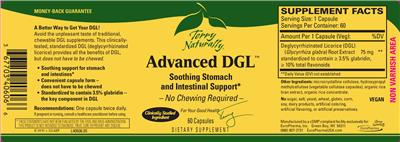
| Deglycyrrhizinated Licorice (DGL) (Glycyrrhiza glabra) root extract (as standardized to contain greater than or equal to Glabridin, greater than or equal to Total Flavonoids)Deglycyrrhizinated Licorice (DGL) (Glycyrrhiza glabra) root extract (Form: standardized to contain greater than or equal to 3.5% Glabridin, greater than or equal to 10% total Flavonoids) (Alt. Name: DGL) PlantPart: root Genus: Glycyrrhiza Species: glabra | 75 mg | † |
Other ingredients: Microcrystalline Cellulose, Hydroxypropyl Methylcellulose, organic Rice Bran extract, organic Rice concentrate
% Daily Values for: Adults and children 4 or more years of age.
Where this label comes from
An original label of the NIH's Dietary Supplement Label Database, entered there on 23 March 2018, shown here as it was entered. The NIH's record
General information
- Product name
- Advanced DGL
- Brand
- Terry Naturally
- Barcode (UPC)
- 3 67703 40606 6
- Net contents
- 60 Capsule(s)
- Market status
- On market
- DSLD ID
- 175053
Classification
Label statements
Formula: Contains: This clinically-tested, standardized DGL (deglycyrrhizinated licorice) provides all the benefits of DGL, but does not have to be chewed.
Directions: Recommendations: One capsule twice daily.
Precautions: Pregnant or Nursing or Prescription Medications: If pregnant or nursing, consult a healthcare practitioner before using.
Directions: No chewing requried
FDA Statement of Identity: Dietary Supplement
Formulation: Does NOT Contain: No sugar, salt, yeast, wheat, gluten, corn, soy, dairy, products, artificial coloring, artificial flavoring, or artificial preservatives.
Brand information
Manufactured by a cGMP Compliant Facility Exclusively for:: EuroPharma, Inc., Green Bay, WI
More labels from Terry Naturally
Labels only: each label is shown as printed on the bottle, with no grades, rankings or advice. A label in this database is not an endorsement of the product. Read the label on the bottle you buy: makers change their formulas. Reverse Age Lab is not affiliated with, or endorsed by, the National Institutes of Health or its Office of Dietary Supplements. The original labels come from the NIH’s public-domain data; the labels since are read by us. Search the Dietary Supplement Label Database.