
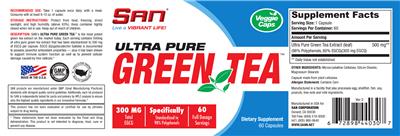
| ultra pure Green Tea extract (as EGCG, Polyphenols)ultra pure Green Tea extract (Form: 98% Polyphenols, 60% EGCG) PlantPart: leaf | 500 mg | † |
| EGCG | 300 mg |
Other ingredients: Microcrystalline Cellulose, Silicon Dioxide, Magnesium Stearate
% Daily Values for: Adults and children 4 or more years of age.
Where this label comes from
An original label of the NIH's Dietary Supplement Label Database, entered there on 24 May 2018, shown here as it was entered. The NIH's record
General information
- Product name
- Ultra Pure Green Tea
- Brand
- SAN
- Barcode (UPC)
- 6 72898 44030 7
- Net contents
- 60 Capsule(s)
- Market status
- On market
- DSLD ID
- 175415
Classification
Label statements
Directions: Recommended Use: Take 1 capsule once daily with a meal. Consume with at least 8-10 oz. of water.
Storage: Storage Instructions: Protect from heat, freezing, direct sunlight, and high humidity (above 65%). Keep container tightly closed when not in use.
Precautions: Children: Keep out of reach of children.
Formula: Contains: Description: SAN's Ultra Pure Green Tea is the most potent green tea extract on the market today. Each serving contains 500mg of ultra pure green tea extract that has been standardized to 300 mg of EGCG per capsule.
Formula: Contains: 300 mg Total EGCG
Formula: Contains: Specifically standardized to 98% polyphenols
FDA Statement of Identity: Dietary Supplement
Formula: Contains: Capsule made from plant cellulose. Allergen Statement: Contains corn
Precautions: Allergies: Allergen Statement: Contains corn Manufactured in a facility that also processes egg, shellfish, fish, soy, peanuts, tree nuts and milk ingredients.
Brand information
Manufactured in USA for:: San Corporation, Oxnard, CA
More labels from SAN
Labels only: each label is shown as printed on the bottle, with no grades, rankings or advice. A label in this database is not an endorsement of the product. Read the label on the bottle you buy: makers change their formulas. Reverse Age Lab is not affiliated with, or endorsed by, the National Institutes of Health or its Office of Dietary Supplements. The original labels come from the NIH’s public-domain data; the labels since are read by us. Search the Dietary Supplement Label Database.