
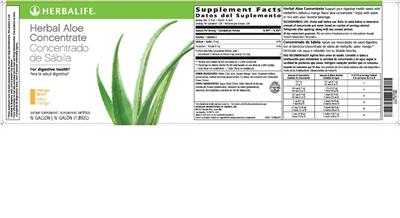
| Calories | 0 {Calories} | |
| Sodium | 10 mg | <1% |
| Potassium | 8 mg | <1% |
| purified Aloe Vera concentrate | 72.3 mg | † |
Other ingredients: Water, Citric Acid, natural Mango flavor, Potassium Sorbate, Sodium Benzoate, Sucralose, Maltodextrin, Chamomile flower extract
% Daily Values for: Adults and children 4 or more years of age.
Where this label comes from
An original label of the NIH's Dietary Supplement Label Database, entered there on 25 January 2013, shown here as it was entered. The NIH's record
General information
- Product name
- Herbal Aloe Concentrate Mango Flavor
- Brand
- Herbalife
- Barcode (UPC)
- 1188
- Net contents
- 0.5 GAL; 1.892 Liter(s)
- Market status
- On market
- DSLD ID
- 17543
Classification
- Supplement form
- Liquid
- Product type
- Botanical with Nutrients
- Claim types on the label
- All Other, Structure/Function
- Intended for
- Adult (18 - 50 Years), Kosher
Label statements
Directions: Enjoy with water or mix with your favorite beverage. RECOMMENDED USE: Shake well before use. Refer to table below to determine amount of concentrate and water based on number of servings desired.
Directions: Amount of Concentrate | Amount of Water Needed | # of 4 fl oz Servings Yielded 1/2 fl oz | 1/2 cup (4 fl oz) | 1 1/4 cup (2 fl oz) | 1 Pint (16 fl oz) | 4 1/2 cup (4 fl oz) | 1 Quart (32 fl oz) | 8 1 cup (8 fl oz) | 2 Quarts (64 fl oz) | 16 1.5 cups (12 fl oz) | 3 Quarts (96 fl oz) | 24 2 cups (16 fl oz) | 1 Gallon (128 fl oz) | 32
FDA Statement of Identity: DIETARY SUPPLEMENT
Storage: Refrigerate after opening, along with any unused portion.
Brand information
Formulated exclusively by: Herbalife International of America, Inc., Los Angeles, CA, USA
More labels from Herbalife
Labels only: each label is shown as printed on the bottle, with no grades, rankings or advice. A label in this database is not an endorsement of the product. Read the label on the bottle you buy: makers change their formulas. Reverse Age Lab is not affiliated with, or endorsed by, the National Institutes of Health or its Office of Dietary Supplements. The original labels come from the NIH’s public-domain data; the labels since are read by us. Search the Dietary Supplement Label Database.