
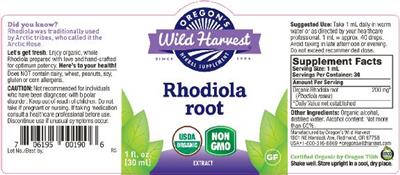
| organic Rhodiola | 200 mg | † |
Other ingredients: organic Alcohol, distilled Water
% Daily Values for: Adults and children 4 or more years of age.
Where this label comes from
An original label of the NIH's Dietary Supplement Label Database, entered there on 25 April 2018, shown here as it was entered. The NIH's record
General information
- Product name
- Rhodiola Root
- Brand
- Oregon's Wild Harvest
- Barcode (UPC)
- 7 06195 00190 6
- Net contents
- 1 fl. Oz.; 30 mL
- Market status
- On market
- DSLD ID
- 176114
Classification
Label statements
Formula: Contains: Let's get fresh. Enjoy organic, whole Rhodiola prepared with love and hand-crafted for optimum potency.
Formulation: Does NOT Contain: Does not contain dairy, wheat, peanuts, soy, gluten or corn allergens.
Precautions: All Other: Caution: Not recommended for individuals who have been diagnosed with bipolar disorder.
Precautions: Children: Keep out of reach of children.
Precautions: Pregnant or Nursing or Prescription Medications: Do not take if pregnant or nursing. If taking medication consult a healthcare professional before use.
Precautions: All Other: Discontinue use if unusual symptoms occur.
FDA Statement of Identity: Herbal Supplement
Formulation: Does NOT Contain: Non GMO
Directions: Suggested Use: Take 1 mL daily in warm water or as directed by your healthcare professional. 1 mL = approx. 40 drops. Avoid taking in late afternoon or evening. Do not exceed recommended dose.
Precautions: All Other: Do not exceed recommended dose.
Formula: Contains: Alcohol content: Not more than 65%.
Directions: Shake well.
Storage: Store upright in a cool, dry place.
Brand information
Manufactured by: Oregon's Wild Harvest, Redmond, OR, USA
More labels from Oregon's Wild Harvest
Labels only: each label is shown as printed on the bottle, with no grades, rankings or advice. A label in this database is not an endorsement of the product. Read the label on the bottle you buy: makers change their formulas. Reverse Age Lab is not affiliated with, or endorsed by, the National Institutes of Health or its Office of Dietary Supplements. The original labels come from the NIH’s public-domain data; the labels since are read by us. Search the Dietary Supplement Label Database.