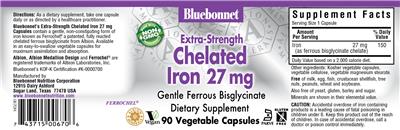
| Iron (as as Ferrous Bisglycinate Chelate)Iron (Form: as Ferrous Bisglycinate Chelate) | 27 mg | 150% |
Other ingredients: Kosher Vegetable Capsules, Vegetable Cellulose, Vegetable Magnesium Stearate
% Daily Values for: Adults and children 4 or more years of age.
Where this label comes from
An original label of the NIH's Dietary Supplement Label Database, entered there on 25 June 2018, shown here as it was entered. The NIH's record
General information
- Product name
- Extra-Strength Chelated Iron 27 mg
- Brand
- Bluebonnet
- Barcode (UPC)
- 7 43715 00670 6
- Net contents
- 90 Vegetable Capsule(s)
- Market status
- Off market
- DSLD ID
- 178243
Classification
Label statements
Directions: Directions: As a dietary supplement, take one capsule daily or as directed by a healthcare practitioner.
Formula: Contains: Bluebonnet’s Extra-Strength Chelated Iron 27 mg Capsules contain a gentle, non-constipating form of iron known as Ferrochel,® a patented, fully reacted chelated ferrous bisglycinate from Albion.
Formulation: Does NOT Contain: Made with non GMO ingredients
Formula: Contains: Gentle Ferrous Bisglycinate
FDA Statement of Identity: Dietary Supplement
Formula: Contains: Ferrochel
Formulation: Does NOT Contain: Free of milk, egg, fish, crustacean shellfish, tree nuts, peanuts, wheat and soybeans. Also free of yeast, gluten, barley and sugar.
Precautions: Children: Caution: Accidental overdose of iron containing products is a leading cause of fatal poisoning in children under 6. Keep this product out of the reach of children. In case of accidental overdose, call a doctor or poison control immediately.
Brand information
Manufactured by: Bluebonnet Nutrition Corporation, Sugar Land, TX, USA
More labels from Bluebonnet
Labels only: each label is shown as printed on the bottle, with no grades, rankings or advice. A label in this database is not an endorsement of the product. Read the label on the bottle you buy: makers change their formulas. Reverse Age Lab is not affiliated with, or endorsed by, the National Institutes of Health or its Office of Dietary Supplements. The original labels come from the NIH’s public-domain data; the labels since are read by us. Search the Dietary Supplement Label Database.