
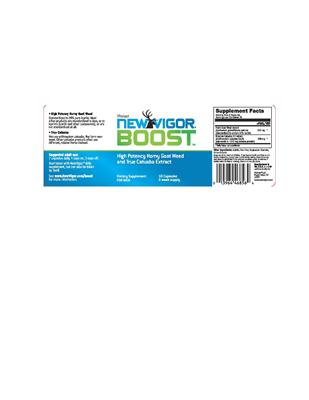
| Horny Goat Weed extract (as standardized to contain Icariin)Horny Goat Weed extract (Form: standardized to contain 20% icariin) PlantPart: whole Genus: Epimedium Species: grandiflorum | 500 mg | † |
| Brazilian Catuaba 4:1 extractBrazilian Catuaba 4:1 extract PlantPart: bark Genus: Erythroxylum Species: catuaba Note: equivalent to 1000 mg catuaba powder | 250 mg | † |
Other ingredients: Gelatin, Rice Flour, Magnesium Stearate, Silicon Dioxide
% Daily Values for: Adults and children 4 or more years of age.
Where this label comes from
An original label of the NIH's Dietary Supplement Label Database, entered there on 25 January 2013, shown here as it was entered. The NIH's record
General information
- Product name
- NewVigor Boost
- Brand
- Vitalast
- Barcode (UPC)
- 0 13964 46856 4
- Net contents
- 50 Capsule(s)
- Market status
- Off market
- DSLD ID
- 17847
Classification
Label statements
Formula: Contains: -True Catuaba
Directions: Suggested adult use: 2 capsules daily, 4 days on, 3 days off.
Formula: Contains: High Potency Horny Goat Weed and True Catuaba Extract
Formula: Contains: -High Potency Horny Goat Weed Standardized to 20% pure icariin.
FDA Statement of Identity: Dietary Supplement
Precautions: Children: Keep out of the reach of children.
Precautions: All Other: If you have a health condition or are taking medication, consult your doctor before taking. Discontinue use and consult a physician if any adverse reactions occur. Do not use if seal is broken or missing.
Storage: Store in a cool, dry place.
Brand information
Manufactured in the U.S.A. in a GMP certified facility for: Vitalast(R) LLC, Pound Ridge, NY, U.S.A.
More labels from Vitalast
Labels only: each label is shown as printed on the bottle, with no grades, rankings or advice. A label in this database is not an endorsement of the product. Read the label on the bottle you buy: makers change their formulas. Reverse Age Lab is not affiliated with, or endorsed by, the National Institutes of Health or its Office of Dietary Supplements. The original labels come from the NIH’s public-domain data; the labels since are read by us. Search the Dietary Supplement Label Database.