| high energy Water | ||
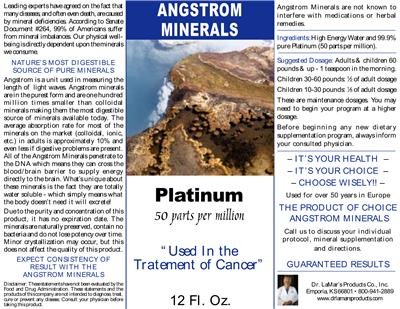
| 99.9% pure Platinum99.9% pure Platinum Note: 50 parts per million |
% Daily Values for: Adults and children 4 or more years of age.
Where this label comes from
An original label of the NIH's Dietary Supplement Label Database, entered there on 21 September 2018, shown here as it was entered. The NIH's record
General information
- Product name
- Platinum
- Brand
- Angstrom Minerals
- Barcode (UPC)
- Not printed
- Net contents
- 12 Fluid Ounce(s)
- Market status
- Off market
- DSLD ID
- 180400
Classification
- Supplement form
- Liquid
- Product type
- Other Combinations
- Claim types on the label
- Nutrient, All Other, Structure/Function
- Intended for
- Adult (18 - 50 Years), Children (All)
Label statements
Formulation: Does NOT Contain: The minerals are naturally preserved, contain no bacteria and do not lose potency over time.
Precautions: All Other: Consult your physician before taking this product.
Formula: Contains: Platinum 50 parts per million
Precautions: Pregnant or Nursing or Prescription Medications: Angstrom Minerals are not known to interfere with medications or herbal remedies.
Directions: Suggested Dosage: Adults & children 60 pounds & up - 1 teaspoon in the morning. Children 30-60 pounds: 1/2 of adult dosage Children 10-30 pounds: 1/8 of adult dosage These are maintenance dosages. You may need to begin your program at a higher dosage. Before beginning any new dietary supplementation program, always inform your consulted physician.
Precautions: All Other: Before beginning any new dietary supplementation program, always inform your consulted physician.
Brand information
Manufacturer: Dr. LaMar's Products Co., Inc., Emporia, KS
More labels from Angstrom Minerals
Labels only: each label is shown as printed on the bottle, with no grades, rankings or advice. A label in this database is not an endorsement of the product. Read the label on the bottle you buy: makers change their formulas. Reverse Age Lab is not affiliated with, or endorsed by, the National Institutes of Health or its Office of Dietary Supplements. The original labels come from the NIH’s public-domain data; the labels since are read by us. Search the Dietary Supplement Label Database.