
Quick Colon Tonic Part 2 Powder
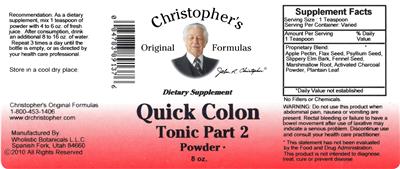
| Proprietary Blend | † | |
| Apple Pectin | ||
| Flax | ||
| Psyllium | ||
| Slippery Elm | ||
| Fennel | ||
| Marshmallow | ||
| activated Charcoal powder | ||
| Plantain |
% Daily Values for: Adults and children 4 or more years of age.
Where this label comes from
An original label of the NIH's Dietary Supplement Label Database, entered there on 25 April 2019, shown here as it was entered. The NIH's record
General information
- Product name
- Quick Colon Tonic Part 2 Powder
- Brand
- Christopher's Original Formulas
- Barcode (UPC)
- 0 84783 89137 6
- Net contents
- 8 oz.
- Market status
- On market
- DSLD ID
- 200619
Classification
- Supplement form
- Powder
- Product type
- Other Combinations
- Claim types on the label
- All Other, Structure/Function
- Intended for
- Adult (18 - 50 Years)
Label statements
Directions: Recommendation: As a dietary supplement, mix 1 teaspoon of powder with 4 to 6 oz. of fresh juice. After consumption, drink an additional 8 to 16 oz. of water. Repeat 3 times a day until the bottle is empty, or as directed by your health care professional.
Storage: Store in a cool dry place.
FDA Statement of Identity: Dietary Supplement
Formulation: Does NOT Contain: No Fillers or Chemicals.
Precautions: All Other: Warning: Do not use this product when abdominal pain, nausea or vomiting are present. Rectal bleeding or failure to have a bowel movement after use of laxative may indicate a serious problem. Discontinue use and consult your health care practitioner.
Brand information
Manufactured by:: Wholistic Botanicals L.L.C., Spanish Fork, UT
More labels from Christopher's Original Formulas
Labels only: each label is shown as printed on the bottle, with no grades, rankings or advice. A label in this database is not an endorsement of the product. Read the label on the bottle you buy: makers change their formulas. Reverse Age Lab is not affiliated with, or endorsed by, the National Institutes of Health or its Office of Dietary Supplements. The original labels come from the NIH’s public-domain data; the labels since are read by us. Search the Dietary Supplement Label Database.