
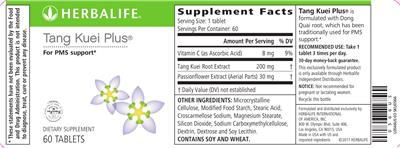
| Vitamin C (as Ascorbic Acid) | 8 mg | 9% |
| Tang Kuei root extract | 200 mg | † |
| Passionflower extract | 30 mg | † |
Other ingredients: Microcrystalline Cellulose, modified Food Starch, Stearic Acid, Croscarmellose Sodium, Magnesium Stearate, Silicon Dioxide, Sodium Carboxymethylcellulose, Dextrin, Dextrose, Soy Lecithin
% Daily Values for: Adults and children 4 or more years of age.
Where this label comes from
An original label of the NIH's Dietary Supplement Label Database, entered there on 24 September 2019, shown here as it was entered. The NIH's record
General information
- Product name
- Tang Kuei Plus
- Brand
- Herbalife
- Barcode (UPC)
- 0566US
- Net contents
- 60 Tablet(s)
- Market status
- On market
- DSLD ID
- 202183
Classification
- Supplement form
- Tablet or Pill
- Product type
- Botanical with Nutrients
- Claim types on the label
- All Other, Structure/Function
- Intended for
- Kosher, Adult Female (18 - 50 Years)
Label statements
FDA Statement of Identity: Dietary Supplement
Formula: Contains: Contains soy and wheat.
Precautions: Allergies: Contains soy and wheat.
Formula: Contains: Tang Kuei Plus is formulated with Dong Quai root, which has been traditionally used for PMS support.
Directions: Recommended use: Take 1 tablet 3 times per day.
Precautions: Pregnant or Nursing or Prescription Medications: Notice: Not recommended for pregnant or lactating women.
Brand information
Formulated and Distributed exclusively by: Herbalife International of America, Inc., Los Angeles, CA, USA
More labels from Herbalife
Labels only: each label is shown as printed on the bottle, with no grades, rankings or advice. A label in this database is not an endorsement of the product. Read the label on the bottle you buy: makers change their formulas. Reverse Age Lab is not affiliated with, or endorsed by, the National Institutes of Health or its Office of Dietary Supplements. The original labels come from the NIH’s public-domain data; the labels since are read by us. Search the Dietary Supplement Label Database.