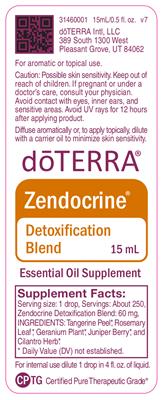
| Zendocrine Detoxification Blend | 60 mg | |
| Tangerine | † | |
| Rosemary | † | |
| Geranium | † | |
| Juniper | † | |
| Cilantro | † |
% Daily Values for: Adults and children 4 or more years of age.
Where this label comes from
An original label of the NIH's Dietary Supplement Label Database, entered there on 28 May 2019, shown here as it was entered. The NIH's record
General information
- Product name
- Zendocrine
- Brand
- doTERRA
- Barcode (UPC)
- Not printed
- Net contents
- 15 mL; 0.5 fl. Oz.
- Market status
- Off market
- DSLD ID
- 203133
Classification
Label statements
Directions: For aromatic or topical use.
Precautions: All Other: Caution: Possible skin sensitivity.
Precautions: Children: Keep out of reach of children.
Precautions: Pregnant or Nursing or Prescription Medications: If pregnant or under a doctor's care, consult your physician.
Precautions: All Other: Avoid contact with eyes, inner ears, and sensitive areas. Avoid UV rays for 12 hours after applying product.
Directions: Diffuse aromatically or, to apply topically, dilute with a carrier oil to minimize skin sensitivity.
Formula: Contains: Detoxification Blend
FDA Statement of Identity: Essential Oil Supplement
Directions: For internal use dilute 1 drop in 4 fl. oz. of liquid.
Brand information
Manufacturer: doTERRA Intl, LLC, Pleasant Grove, UT
More labels from doTERRA
Labels only: each label is shown as printed on the bottle, with no grades, rankings or advice. A label in this database is not an endorsement of the product. Read the label on the bottle you buy: makers change their formulas. Reverse Age Lab is not affiliated with, or endorsed by, the National Institutes of Health or its Office of Dietary Supplements. The original labels come from the NIH’s public-domain data; the labels since are read by us. Search the Dietary Supplement Label Database.