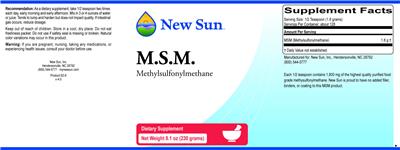
| MSM | 1.8 g | † |
% Daily Values for: Adults and children 4 or more years of age.
Where this label comes from
An original label of the NIH's Dietary Supplement Label Database, entered there on 24 September 2019, shown here as it was entered. The NIH's record
General information
- Product name
- M.S.M. Methylsulfonylmethane
- Brand
- New Sun
- Barcode (UPC)
- 62-8
- Net contents
- 8.1 oz.; 230 Gram(s)
- Market status
- On market
- DSLD ID
- 203353
Classification
- Supplement form
- Powder
- Product type
- Non-Nutrient/Non-Botanical
- Claim types on the label
- All Other
- Intended for
- Adult (18 - 50 Years)
Label statements
Directions: Recommendation: As a dietary supplement, take 1/2 teaspoon two times each day, early morning and early afternoon. Mix in 3 or 4 ounces of water or juice. Tends to lump and harden but does not impact quality. If intestinal gas occurs, reduce dosage.
Precautions: All Other: If intestinal gas occurs, reduce dosage.
Precautions: Children: Keep out of reach of children.
Storage: Store in a cool, dry place.
Precautions: All Other: Do not eat freshness packet.
Precautions: All Other: Do not use if safety seal is missing or broken.
Precautions: Pregnant or Nursing or Prescription Medications: Warning: If you are pregnant, nursing, taking any medications, or experiencing health issues, consult your doctor before use.
FDA Statement of Identity: Dietary supplement
Formula: Contains: Each 1/2 teaspoon contains 1,800 mg of the highest quality purified food grade methysulfonylmethane.
Formulation: Does NOT Contain: New Sun is proud to have no added filler, binders, or coating to this MSM product.
Brand information
Manufactured for: New Sun, Inc., Hendersonville, NC
More labels from New Sun
Labels only: each label is shown as printed on the bottle, with no grades, rankings or advice. A label in this database is not an endorsement of the product. Read the label on the bottle you buy: makers change their formulas. Reverse Age Lab is not affiliated with, or endorsed by, the National Institutes of Health or its Office of Dietary Supplements. The original labels come from the NIH’s public-domain data; the labels since are read by us. Search the Dietary Supplement Label Database.