
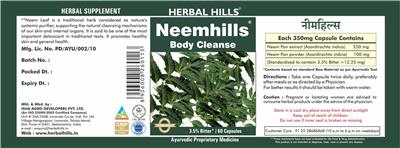
| Neem Pan extract | 250 mg | |
| Neem Pan powder (as standardized to contain Bitter)Neem Pan powder (Form: standardized to contain 3.5% Bitter Note: = 12.25 mg) Genus: Azardirachta Species: indica | 100 mg |
% Daily Values for: Adults and children 4 or more years of age.
Where this label comes from
An original label of the NIH's Dietary Supplement Label Database, entered there on 24 June 2019, shown here as it was entered. The NIH's record
General information
- Product name
- Neemhills
- Brand
- Herbal Hills
- Barcode (UPC)
- 8 906008 260113
- Net contents
- 60 Capsule(s)
- Market status
- On market
- DSLD ID
- 203761
Classification
Label statements
FDA Statement of Identity: Herbal Supplement
Formula: Contains: Neem Leaf is a traditional herb considered as nature's sytemic purifier, supporting the natural cleansing mechanisms of our skin and internal organs. It is said to be one of the most important detoxicant in traditional texts. It promotes healthy skin and general health.
Formula: Contains: Standardized extract 3.5% Bitter
Directions: Directions: Take one Capsule twice daily, preferably after meals or as directed by a Physician. For better results it should be taken with warm water.
Precautions: Pregnant or Nursing or Prescription Medications: Caution: Pregnant or lactating women are advised to consume herbal products under the advice of the physician.
Storage: Store in a cool dry place away from direct sunlight
Precautions: Children: Keep out of reach of children.
Precautions: All Other: Do not use if inner seal is broken or missing
Brand information
Manufactured & Marketed by: Isha Agro Developers Pvt. Ltd., Village-Nangargaon, Lonavala, Taluka-Maval, Dist. Pune, Maharashtra, India
More labels from Herbal Hills
Labels only: each label is shown as printed on the bottle, with no grades, rankings or advice. A label in this database is not an endorsement of the product. Read the label on the bottle you buy: makers change their formulas. Reverse Age Lab is not affiliated with, or endorsed by, the National Institutes of Health or its Office of Dietary Supplements. The original labels come from the NIH’s public-domain data; the labels since are read by us. Search the Dietary Supplement Label Database.