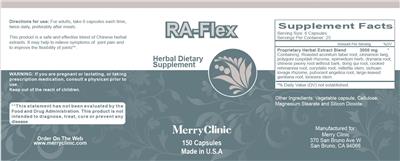
| Proprietary Herbal Extract BlendProprietary Herbal Extract Blend Note: containing | 3,000 mg | † |
| Roasted Aconitum | ||
| Cinnamon | ||
| Polygoni cuspidati | ||
| Epimedium | ||
| Drynaria | ||
| Chinese Peony | ||
| Dong Quai | ||
| cooked Rehmannia | ||
| Corydalis | ||
| Millettia | ||
| Sichuan Lovage | ||
| pubscent Angelica | ||
| large-leaved Gentiana | ||
| Lonicera |
Other ingredients: Vegetable Capsule, Cellulose, Magnesium Stearate, Silicon Dioxide
% Daily Values for: Adults and children 4 or more years of age.
Where this label comes from
An original label of the NIH's Dietary Supplement Label Database, entered there on 24 July 2019, shown here as it was entered. The NIH's record
General information
- Product name
- RA-Flex
- Brand
- Merry Clinic
- Barcode (UPC)
- Not printed
- Net contents
- 150 Capsule(s)
- Market status
- On market
- DSLD ID
- 205101
Classification
Label statements
Directions: Directions for use: For adults, take 6 capsules each time, twice daily, preferably after meals.
Precautions: Pregnant or Nursing or Prescription Medications: Warning: If you are pregnant or lactating, or taking prescription medication, consult a physician prior to use.
Precautions: Children: Keep out of the reach of children.
FDA Statement of Identity: Herbal Dietary Supplement
Brand information
Manufactured for: Merry Clinic LLC., San Bruno, CA
More labels from Merry Clinic
Labels only: each label is shown as printed on the bottle, with no grades, rankings or advice. A label in this database is not an endorsement of the product. Read the label on the bottle you buy: makers change their formulas. Reverse Age Lab is not affiliated with, or endorsed by, the National Institutes of Health or its Office of Dietary Supplements. The original labels come from the NIH’s public-domain data; the labels since are read by us. Search the Dietary Supplement Label Database.