
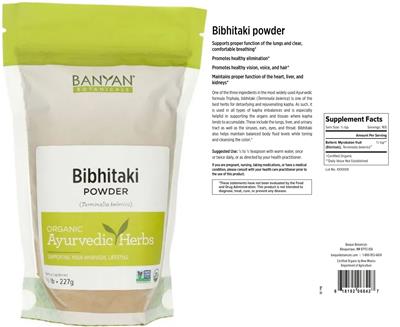
| Belleric MyrobalanBelleric Myrobalan (Alt. Name: Bibhitaki) PlantPart: fruit Genus: Terminalia Species: belerica Note: certified organic | 0.5 Teaspoon | † |
% Daily Values for: Adults and children 4 or more years of age.
Where this label comes from
An original label of the NIH's Dietary Supplement Label Database, entered there on 24 July 2019, shown here as it was entered. The NIH's record
General information
- Product name
- Bibhitaki Powder
- Brand
- Banyan Botanicals
- Barcode (UPC)
- 6 18192 06842 7
- Net contents
- 0.5 lb; 227 Gram(s)
- Market status
- Off market
- DSLD ID
- 205405
Classification
Label statements
Formula: Contains: Terminalia belerica
FDA Statement of Identity: Dietary Supplement
Formulation: Does NOT Contain: Non GMO
Storage: USDA Organic
Formula: Contains: One of the three ingredients in the most widely used Ayurvedic formula Triphala, bibhitaki (Terminalia belerica) is one of the best herbs for detoxifying and rejuvenating kapha. As such, it is used in all types of kapha imbalances and is especially helpful in supporting the organs and tissues where kapha tends to accumulate. These include the lungs, liver, and urinary tract as well as the sinuses, ears, eyes, and throat. Bibhitaki also helps maintain balanced body fluid levels while toning and cleansing the colon.
Directions: Suggested use: 1/4 to 1/2 teaspoon with warm water, once or twice daily, or as directed by your health practitioner.
Precautions: Pregnant or Nursing or Prescription Medications: If you are pregnant, nursing, taking medications, or have a medical condition, please consult with your health care practitioner prior to the use of this product.
Brand information
Manufacturer: Banyan Botanicals, Albuquerque, NM, USA
More labels from Banyan Botanicals
Labels only: each label is shown as printed on the bottle, with no grades, rankings or advice. A label in this database is not an endorsement of the product. Read the label on the bottle you buy: makers change their formulas. Reverse Age Lab is not affiliated with, or endorsed by, the National Institutes of Health or its Office of Dietary Supplements. The original labels come from the NIH’s public-domain data; the labels since are read by us. Search the Dietary Supplement Label Database.