
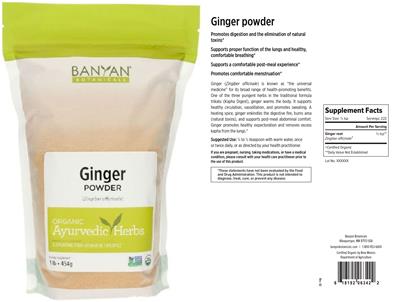
| GingerGinger PlantPart: root Genus: Zingiber Species: officinale Note: certified organic | 0.5 Teaspoon | † |
% Daily Values for: Adults and children 4 or more years of age.
Where this label comes from
An original label of the NIH's Dietary Supplement Label Database, entered there on 24 July 2019, shown here as it was entered. The NIH's record
General information
- Product name
- Ginger Powder
- Brand
- Banyan Botanicals
- Barcode (UPC)
- 6 18192 06342 2
- Net contents
- 0.5 lb; 227 Gram(s)
- Market status
- Off market
- DSLD ID
- 205505
Classification
Label statements
Formula: Contains: Zingiber officinale
FDA Statement of Identity: Dietary Supplement
Formulation: Does NOT Contain: Non GMO
Formula: Contains: Ginger (Zingiber officinale) is known as “the universal medicine” for its broad range of health-promoting benefits. One of the three pungent herbs in the traditional formula trikatu (Kapha Digest), ginger warms the body. It supports healthy circulation, vasodilation, and promotes sweating. A heating spice, Ginger enkindles the digestive fire, burns ama (natural toxins), and supports post-meal abdominal comfort. Ginger promotes healthy expectoration and removes excess kapha from the lungs.
Directions: Suggested use: 1/4 to 1/2 teaspoon with warm water, once or twice daily, or as directed by your health practitioner.
Precautions: Pregnant or Nursing or Prescription Medications: If you are pregnant, nursing, taking medications, or have a medical condition, please consult with your health care practitioner prior to the use of this product.
Brand information
Manufacturer: Banyan Botanicals, Albuquerque, NM, USA
More labels from Banyan Botanicals
Labels only: each label is shown as printed on the bottle, with no grades, rankings or advice. A label in this database is not an endorsement of the product. Read the label on the bottle you buy: makers change their formulas. Reverse Age Lab is not affiliated with, or endorsed by, the National Institutes of Health or its Office of Dietary Supplements. The original labels come from the NIH’s public-domain data; the labels since are read by us. Search the Dietary Supplement Label Database.