
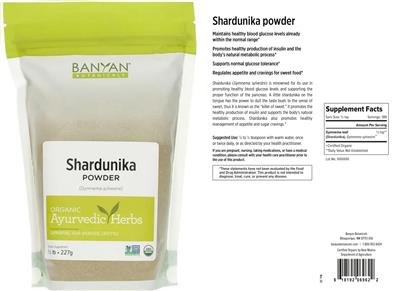
| GymnemaGymnema (Alt. Name: Shardunika) PlantPart: leaf Genus: Gymnema Species: sylvestre Note: certified organic | 0.5 Teaspoon | † |
% Daily Values for: Adults and children 4 or more years of age.
Where this label comes from
An original label of the NIH's Dietary Supplement Label Database, entered there on 23 August 2019, shown here as it was entered. The NIH's record
General information
- Product name
- Shardunika Powder
- Brand
- Banyan Botanicals
- Barcode (UPC)
- 6 18192 06962 2
- Net contents
- 0.5 lb; 227 Gram(s)
- Market status
- Off market
- DSLD ID
- 205637
Classification
Label statements
Formula: Contains: Gymnema sylvestre
FDA Statement of Identity: Dietary Supplement
Formulation: Does NOT Contain: Non GMO
Formula: Contains: Shardunika (Gymnema sylvestre) is renowned for its use in promoting healthy blood glucose levels and supporting the proper function of the pancreas. A little Shardunika on the tongue has the power to dull the taste buds to the sense of sweet, thus it is known as the “killer of sweet.” It promotes the healthy production of insulin and supports the body's natural metabolic process. Shardunika also promotes healthy management of appetite and sugar cravings.
Directions: Suggested use: 1/4 to 1/2 teaspoon with warm water, once or twice daily, or as directed by your health practitioner.
Precautions: Pregnant or Nursing or Prescription Medications: If you are pregnant, nursing, taking medications, or have a medical condition, please consult with your health care practitioner prior to the use of this product.
Brand information
Manufacturer: Banyan Botanicals, Albuquerque, NM, USA
More labels from Banyan Botanicals
Labels only: each label is shown as printed on the bottle, with no grades, rankings or advice. A label in this database is not an endorsement of the product. Read the label on the bottle you buy: makers change their formulas. Reverse Age Lab is not affiliated with, or endorsed by, the National Institutes of Health or its Office of Dietary Supplements. The original labels come from the NIH’s public-domain data; the labels since are read by us. Search the Dietary Supplement Label Database.