
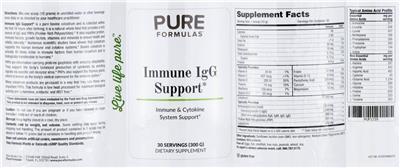
| Calories | 49 | |
| Calories from Fat | 2.88 | |
| Total Fat | <1 g | 2% |
| Sodium | 20 mg | 1% |
| Potassium | 10 mg | <1% |
| Total Carbohydrates | 5.13 g | 2% |
| Sugar | 5.13 g | † |
| Protein | 6.4 g | 13% |
| Typically Provides | ||
| Vitamin A | 25 IU | 1% |
| Vitamin C | 457 mcg | <1% |
| Vitamin D | 220 IU | 55% |
| Thiamine | 0.15 mg | 10% |
| Riboflavin | 120 mcg | 7% |
| Vitamin B6 | 20 mcg | 1% |
| Folate | 12 mcg | 3% |
| Vitamin B12 | 0.6 mcg | 10% |
| Pantothenic Acid | 329 mcg | 3% |
| Calcium | 50 mg | 5% |
| Magnesium | 10 mg | 2.5% |
| Colostrum | 10,000 mg | † |
| Typically Provides | ||
| ImmunoglobulinsImmunoglobulins Note: total | 2,500 mg | † |
| Immunoglobulin G | 2,240 mg | † |
| Other Immunoglobulins (as IgA, IgD, IgE, IgM) | 260 mg | † |
| Proline-Rich Polypeptides | 400 mg | † |
| Lactoferin | <50 mg | † |
Other ingredients: Sunflower Lecithin, Medium Chain Triglycerides
% Daily Values for: Adults and children 4 or more years of age.
Where this label comes from
An original label of the NIH's Dietary Supplement Label Database, entered there on 23 August 2019, shown here as it was entered. The NIH's record
General information
- Product name
- Immune IgG Support
- Brand
- PureFormulas
- Barcode (UPC)
- PUF1159
- Net contents
- 30 Serving(s); 300 Gram(s)
- Market status
- Off market
- DSLD ID
- 205657
Classification
- Supplement form
- Powder
- Product type
- Other Combinations
- Claim types on the label
- Nutrient, All Other, Structure/Function
- Intended for
- Adult (18 - 50 Years)
Label statements
Directions: Directions: Mix one scoop (10 grams) in unchilled water or other beverage once daily or as directed by your healthcare practitioner.
Formula: Contains: Immune IgG Support is a pure bovine colostrum and is collected within the first 16 hours after birthing. It is a natural whole food that provides a rich source of igG and PRPs (Proline-Rich Polypeptides). It also supplies protein, immune factors, growth factors, vitamins and minerals to ensure health and vitality naturally. Numerous scientific studies have shown that colostrum supports the human immune and cytokine systems. Bovine colostrum is actually 40 times richer in immune factors than human colostrum and is biologically transferable to humans.
Formula: Contains: PRPs are information-carrying proteins (peptides) with amazing adaptability. They support the body's balance production of cytokines by sending signals via specific cell receptor sites. PRPs also support the thymus gland, which is known as the body's central command for the immune system. Many colostrum products are produced in a way that they lose these very important PRPs. This formula is low heat processed for maximum biological activity and is hormone, antibiotic and rBST free.
Formulation: Does NOT Contain: This formula is low heat processed for maximum biological activity and is hormone, antibiotic and rBST free.
Precautions: Pregnant or Nursing or Prescription Medications: Caution: Do not use if you are pregnant or if you have received an organ transplant.
Precautions: Children: Keep out of reach of children.
Storage: Storage: Keep tightly closed in a cool, dry place.
Formulation: Does NOT Contain: Does not contain artificial colors, sweeteners and preservatives.
FDA Statement of Identity: Dietary Supplement
Formula: Contains: Contains: Milk proteins.
Precautions: Allergies: Contains: Milk proteins.
Formulation: Does NOT Contain: Free of: Eggs, fish, shellfish, tree nuts, peanuts, wheat, soy.
Precautions: All Other: To report a serious adverse event, call: 866.787.5175
Formulation: Does NOT Contain: Gluten free
Brand information
Distributed by: PureFormulas, Miami, FL
More labels from PureFormulas
Labels only: each label is shown as printed on the bottle, with no grades, rankings or advice. A label in this database is not an endorsement of the product. Read the label on the bottle you buy: makers change their formulas. Reverse Age Lab is not affiliated with, or endorsed by, the National Institutes of Health or its Office of Dietary Supplements. The original labels come from the NIH’s public-domain data; the labels since are read by us. Search the Dietary Supplement Label Database.