
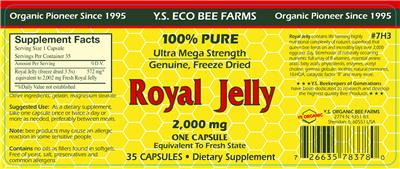
| Royal JellyRoyal Jelly Note: (freeze dried 3.5x) (equivalent to 2,002 mg fresh Royal Jelly) | 572 mg | † |
Other ingredients: Gelatin, Magnesium Stearate
% Daily Values for: Adults and children 4 or more years of age.
Where this label comes from
An original label of the NIH's Dietary Supplement Label Database, entered there on 23 August 2019, shown here as it was entered. The NIH's record
General information
- Product name
- Royal Jelly 2,000 mg
- Brand
- Y.S. Eco Bee Farms
- Barcode (UPC)
- 7 26635 78378 0
- Net contents
- 35 Capsule(s)
- Market status
- On market
- DSLD ID
- 205741
Classification
- Supplement form
- Capsule
- Product type
- Non-Nutrient/Non-Botanical
- Claim types on the label
- All Other
- Intended for
- Adult (18 - 50 Years), Organic
Label statements
Directions: Suggested Use: As a dietary supplement, take one capsule once or twice a day or more as needed, preferably between meals
Precautions: Allergies: Note: Bee products may cause an allergic reaction in some sensitive people.
Formulation: Does NOT Contain: Contains no oils as fillers found in softgels. Free of yeast, salt, preservatives and common allergens.
FDA Statement of Identity: Dietary Supplement
Formula: Contains: Royal Jelly contains life forming highly nutritional complexity of nature’s superfood that queen bee feeds on and incredibly lays over 2,000 eggs per day. Storehouse of naturally occurring nutrients: full array of B-vitamins, essential Amino Acids, Fatty Acids, Phytosterols, Enzymes, Acetyl Choline, Gamma Globulin, Lecithin, natural hormones, 10-HDA, catalystic factor “R” and many more.
Brand information
Manufacturer: Y.S. Organic Bee Farms, Sheridan, IL, USA
More labels from Y.S. Eco Bee Farms
Labels only: each label is shown as printed on the bottle, with no grades, rankings or advice. A label in this database is not an endorsement of the product. Read the label on the bottle you buy: makers change their formulas. Reverse Age Lab is not affiliated with, or endorsed by, the National Institutes of Health or its Office of Dietary Supplements. The original labels come from the NIH’s public-domain data; the labels since are read by us. Search the Dietary Supplement Label Database.