
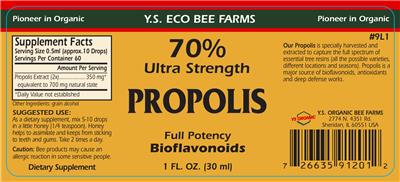
| Propolis extractPropolis extract Note: (2x) (equivalent to 700 mg natural state) | 350 mg | † |
Other ingredients: Grain Alcohol
% Daily Values for: Adults and children 4 or more years of age.
Where this label comes from
An original label of the NIH's Dietary Supplement Label Database, entered there on 23 August 2019, shown here as it was entered. The NIH's record
General information
- Product name
- 70% Ultra Strength Propolis
- Brand
- Y.S. Eco Bee Farms
- Barcode (UPC)
- 7 26635 91201 2
- Net contents
- 1 fl. Oz.; 30 mL
- Market status
- On market
- DSLD ID
- 205857
Classification
Label statements
Directions: Suggested use: As a dietary supplement, mix 5-10 drops in a little honey (1/4 teaspoon). Honey helps to assimilate and keeps from sticking to teeth and gums. Take 2 times a day.
Precautions: Allergies: Caution: Bee products may cause an allergic reaction in some sensitive people.
FDA Statement of Identity: Dietary Supplement
Formula: Contains: Full potency Bioflavonoids Our Propolis is specially harvested and extracted to capture the full spectrum of essential tree resins (all the possible varieties, different locations and seasons). Propolis is a major source of Bioflavonoids, antioxidants and deep defense works.
Brand information
Manufacturer: Y.S. Organic Bee Farms, Sheridan, IL, USA
More labels from Y.S. Eco Bee Farms
Labels only: each label is shown as printed on the bottle, with no grades, rankings or advice. A label in this database is not an endorsement of the product. Read the label on the bottle you buy: makers change their formulas. Reverse Age Lab is not affiliated with, or endorsed by, the National Institutes of Health or its Office of Dietary Supplements. The original labels come from the NIH’s public-domain data; the labels since are read by us. Search the Dietary Supplement Label Database.