
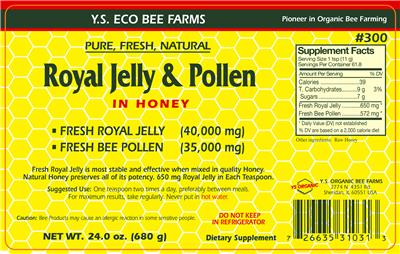
| Calories | 39 | |
| Total Carbohydrates | 9 g | 3% |
| Sugar | 7 g | |
| fresh Royal Jelly | 650 mg | † |
| fresh Bee Pollen | 572 mg | † |
Other ingredients: raw Honey
% Daily Values for: Adults and children 4 or more years of age.
Where this label comes from
An original label of the NIH's Dietary Supplement Label Database, entered there on 23 August 2019, shown here as it was entered. The NIH's record
General information
- Product name
- Royal Jelly & Pollen in Honey
- Brand
- Y.S. Eco Bee Farms
- Barcode (UPC)
- 7 26635 31031 3
- Net contents
- 24 Oz(s); 680 Gram(s)
- Market status
- On market
- DSLD ID
- 205903
Classification
- Supplement form
- Other (e.g. tea bag)
- Product type
- Non-Nutrient/Non-Botanical
- Claim types on the label
- All Other
- Intended for
- Adult (18 - 50 Years), Organic
Label statements
Formula: Contains: Fresh Royal Jelly (40,000 mg) Fresh Bee Pollen (35,000 mg) Fresh Royal Jelly is most stable and effective when mixed in quality Honey. Natural Honey preserves all of its potency. 650 mg Royal Jelly in Each Teaspoon.
Directions: Suggested Use: One teaspoon two times a day, preferably between meals. For maximum results, take regularly. Never put in hot water.
Precautions: Allergies: Caution: Bee Products may cause an allergic reaction in some sensitive people.
Storage: Do not keep in refrigerator
FDA Statement of Identity: Dietary Supplement
Brand information
Manufacturer: Y.S. Organic Bee Farms, Sheridan, IL, USA
More labels from Y.S. Eco Bee Farms
Labels only: each label is shown as printed on the bottle, with no grades, rankings or advice. A label in this database is not an endorsement of the product. Read the label on the bottle you buy: makers change their formulas. Reverse Age Lab is not affiliated with, or endorsed by, the National Institutes of Health or its Office of Dietary Supplements. The original labels come from the NIH’s public-domain data; the labels since are read by us. Search the Dietary Supplement Label Database.