
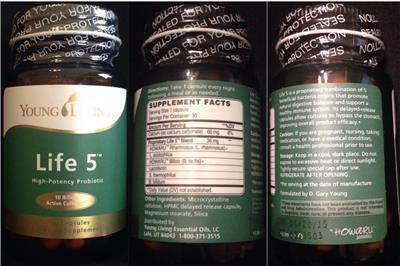
| Calcium (as Calcium Carbonate)Calcium (Form: as Calcium Carbonate) | 60 mg | 6% |
| Proprietary Life 5 Blend | 36 mg | † |
| HOWARU rhamnosusHOWARU rhamnosus Genus: L. Species: rhamnosus Note: Per serving at the date of manufacture | ||
| L. acidophilus | ||
| HOWARU BifidoHOWARU Bifido Genus: B. Species: lactis Note: Per serving at the date of manufacture | ||
| Lactoferrin | ||
| S. thermophilus | ||
| B. bifidum |
Other ingredients: Microcrystalline Cellulose, HPMC, Magnesium Stearate, Silica
% Daily Values for: Adults and children 4 or more years of age.
Where this label comes from
An original label of the NIH's Dietary Supplement Label Database, entered there on 21 November 2019, shown here as it was entered. The NIH's record
General information
- Product name
- Life 5
- Brand
- Young Living
- Barcode (UPC)
- Not printed
- Net contents
- 30 Capsule(s)
- Market status
- On market
- DSLD ID
- 208423
Classification
- Supplement form
- Capsule
- Product type
- Other Combinations
- Claim types on the label
- All Other, Structure/Function
- Intended for
- Adult (18 - 50 Years)
Label statements
FDA Statement of Identity: Dietary Supplement
Directions: Directions: Take 1 capsule every night following a meal or as needed.
Precautions: Pregnant or Nursing or Prescription Medications: Caution: If you are pregnant, nursing, taking medication, or have a medical condition, consult a health professional prior to use.
Storage: Storage: Keep in a cool, dark place. Do not expose to excessive heat or direct sunlight. Tightly secure special cap after use. Refrigerate after opening.
Formula: Contains: HOWARU probiotics
Brand information
Distributed by: Young Living Essential Oils, LC, Lehi, UT
More labels from Young Living
Labels only: each label is shown as printed on the bottle, with no grades, rankings or advice. A label in this database is not an endorsement of the product. Read the label on the bottle you buy: makers change their formulas. Reverse Age Lab is not affiliated with, or endorsed by, the National Institutes of Health or its Office of Dietary Supplements. The original labels come from the NIH’s public-domain data; the labels since are read by us. Search the Dietary Supplement Label Database.