
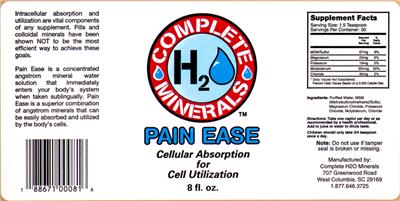
| MSM/Sulfur | 57 mg | 9% |
| Magnesium | 23 mg | 6% |
| Potassium | 19 mg | 0% |
| Molybdenum | 50 mcg | 50% |
| Chloride | 40 mg | 2% |
Other ingredients: purified Water, MSM (Methylsulfonylmethane)/Sulfur, Magnesium Chloride, Potassium Chloride, Molybdenum, Chloride
% Daily Values for: Adults and children 4 or more years of age.
Where this label comes from
An original label of the NIH's Dietary Supplement Label Database, entered there on 21 November 2019, shown here as it was entered. The NIH's record
General information
- Product name
- Pain Ease
- Brand
- Complete H2O Minerals
- Barcode (UPC)
- 1 88671 00081 6
- Net contents
- 8 fl. Oz.
- Market status
- On market
- DSLD ID
- 208850
Classification
- Supplement form
- Liquid
- Product type
- Other Combinations
- Claim types on the label
- Nutrient, All Other, Structure/Function
- Intended for
- Adult (18 - 50 Years), Children (All)
Label statements
Formula: Contains: Pain Ease is a concentrated angstrom mineral water solution that immediately enters your body's system when taken sublingually. Pain Ease is a superior combination of angstrom minerals that can be easily absorbed and utilized by the body's cells.
Directions: Pain Ease is a concentrated angstrom mineral water solution that immediately enters your body's system when taken sublingually.
Directions: Directions: Take one capful per day or as recommended by a health professional. Add to juice or water to dilute taste. Children should only take 3/4 teaspoon once a day.
Precautions: All Other: Note: Do not use if tamper seal is broken or missing.
Brand information
Manufactured by: Complete H2O Minerals, West Columbia, SC
More labels from Complete H2O Minerals
Labels only: each label is shown as printed on the bottle, with no grades, rankings or advice. A label in this database is not an endorsement of the product. Read the label on the bottle you buy: makers change their formulas. Reverse Age Lab is not affiliated with, or endorsed by, the National Institutes of Health or its Office of Dietary Supplements. The original labels come from the NIH’s public-domain data; the labels since are read by us. Search the Dietary Supplement Label Database.