
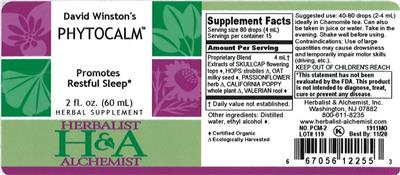
| Proprietary BlendProprietary Blend Note: extracts of | 4 mL | † |
| Skullcap flowering tops extractSkullcap flowering tops extract PlantPart: flowering tops Note: certified organic | ||
| Hops strobile extractHops strobile extract PlantPart: strobile Note: ecologically harvested | ||
| Oat milky seed extractOat milky seed extract PlantPart: milky seed Note: certified organic | ||
| Passionflower herb extractPassionflower herb extract PlantPart: herb Note: ecologically harvested | ||
| California Poppy whole plant extractCalifornia Poppy whole plant extract PlantPart: whole plant Note: ecologically harvested | ||
| Valerian root extractValerian root extract PlantPart: root Note: certified organic |
Other ingredients: distilled Water, Ethyl Alcohol
% Daily Values for: Adults and children 4 or more years of age.
Where this label comes from
An original label of the NIH's Dietary Supplement Label Database, entered there on 21 November 2019, shown here as it was entered. The NIH's record
General information
- Product name
- David Winston's Phytocalm
- Brand
- Herbalist & Alchemist
- Barcode (UPC)
- 6 67056 12255 3
- Net contents
- 2 fl. Oz.; 60 mL
- Market status
- On market
- DSLD ID
- 209322
Classification
Label statements
FDA Statement of Identity: Herbal Supplement
Directions: Suggested use: 40-80 drops (2-4 mL) ideally in Chamomile tea. Can also be taken in juice or water. Take in the evening. Shake well before using.
Precautions: All Other: Contraindications: Use of large quantities may cause drowsiness and temporarily impair motor skills (driving, etc.).
Precautions: Children: Keep out of children's reach
Brand information
Manufacturer: Herbalist & Alchemist, Inc., Washington, NJ
More labels from Herbalist & Alchemist
Labels only: each label is shown as printed on the bottle, with no grades, rankings or advice. A label in this database is not an endorsement of the product. Read the label on the bottle you buy: makers change their formulas. Reverse Age Lab is not affiliated with, or endorsed by, the National Institutes of Health or its Office of Dietary Supplements. The original labels come from the NIH’s public-domain data; the labels since are read by us. Search the Dietary Supplement Label Database.