
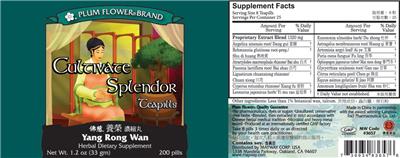
| Proprietary Extract Blend | 1,320 mg | |
| Angelica sinensis | † | |
| Rehmannia glutinosaRehmannia glutinosa (Alt. Name: Sheng di huang) PlantPart: root Genus: Rehmannia Species: glutinosa Note: prep. | † | |
| Atractylodes macrocephala | † | |
| Paeonia lactiflora | † | |
| Ligusticum chuanxiong | † | |
| Cyperus rotundus | † | |
| Leonurus japonicus | † | |
| Eucommia ulmoides | † | |
| Astragalus membranaceus | ||
| Artemisia argyi | † | |
| Poria cocos fungus | † | |
| Ophiopogon japonicus | † | |
| Glycyrrhiza uralensis | † | |
| Citrus reticulata | † | |
| Equus asinus Gelatin | † | |
| Amomum longiligulare | † |
Other ingredients: Less than 1%
% Daily Values for: Adults and children 4 or more years of age.
Where this label comes from
An original label of the NIH's Dietary Supplement Label Database, entered there on 22 December 2019, shown here as it was entered. The NIH's record
General information
- Product name
- Cultivate Splendor Teapills
- Brand
- Plum Flower Brand
- Barcode (UPC)
- 7 39934 83657 6
- Net contents
- 1.2 oz.; 33 Gram(s); 200 Pill(s)
- Market status
- Off market
- DSLD ID
- 209863
Classification
- Supplement form
- Tablet or Pill
- Product type
- Other Combinations
- Claim types on the label
- All Other
- Intended for
- Adult (18 - 50 Years), Sugar Free
Label statements
FDA Statement of Identity: Herbal Dietary Supplement
Formulation: Does NOT Contain: Plum Flower quality guarantee No pharmaceuticals, dyes or sugars Unsulfured, preservative-free herbs
Directions: Take 8 pills 3 times daily or as directed by your health care practitioner.
Precautions: Allergies: Contains soy.
Brand information
Distributed by: MAYWAY CORP. USA, Oakland, CA
More labels from Plum Flower Brand
Labels only: each label is shown as printed on the bottle, with no grades, rankings or advice. A label in this database is not an endorsement of the product. Read the label on the bottle you buy: makers change their formulas. Reverse Age Lab is not affiliated with, or endorsed by, the National Institutes of Health or its Office of Dietary Supplements. The original labels come from the NIH’s public-domain data; the labels since are read by us. Search the Dietary Supplement Label Database.