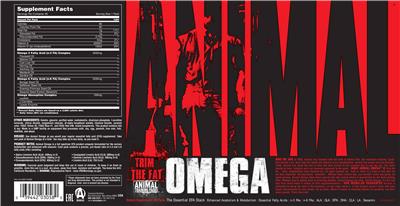
| Calories | 60 | |
| Calories from Fat | 60 | |
| Total Fat | 7 g | 11% |
| Saturated Fat | 1 g | 5% |
| Polyunsaturated Fat | 2.75 g | † |
| Cholesterol | 5 mg | 2% |
| Vitamin A | 2,000 IU | 40% |
| Vitamin D (as Cholecalciferol)Vitamin D (Form: as Cholecalciferol) | 100 IU | 25% |
| Omega 3 Fatty Acid (n-3 FA) Complex | 4,000 mg | |
| Flaxseed Oil | † | |
| Salmon Oil | † | |
| Cod Liver Oil | † | |
| Herring Oil | † | |
| Anchovy Oil | † | |
| Mackerel Oil | † | |
| Sardine Oil | † | |
| Omega 6 Fatty Acid (n-6 FA) Complex | 2,500 mg | |
| Borage seed Oil | † | |
| Safflower seed Oil | † | |
| Evening Primrose seed Oil | † | |
| Sesame seed extract (as Sesamin) | † | |
| Omega Absorption Complex | 200 mg | |
| Lecithin | † | |
| L-Carnitine | † | |
| LipaseLipase Enzyme | † |
Other ingredients: Gelatin, Glycerin, purified Water, Maltodextrin, Dicalcium Phosphate, L-Carnitine Fumarate, Silicon Dioxide, Magnesium Stearate, DL-Alpha-Tocopherol Acetate, Titanium Dioxide, Caramel color, FD&C Yellow #5, FD&C Blue #1, FD&C Red #40, Mixed Tocopherols
% Daily Values for: Adults and children 4 or more years of age.
Where this label comes from
An original label of the NIH's Dietary Supplement Label Database, entered there on 22 December 2019, shown here as it was entered. The NIH's record
General information
- Product name
- Animal Omega
- Brand
- Animal
- Barcode (UPC)
- 0 39442 03058 0
- Net contents
- 30 Pack(s)
- Market status
- Off market
- DSLD ID
- 210557
Classification
- Supplement form
- Other (e.g. tea bag)
- Product type
- Other Combinations
- Claim types on the label
- Nutrient, All Other, Structure/Function
- Intended for
- Adult (18 - 50 Years)
Label statements
Precautions: Allergies: This product contains fish & soy. Made in a GMP facility on equipment that processes milk, soy, egg, peanuts, tree nuts, fish, shellfish, and wheat.
Formula: Contains: This product contains fish & soy.
Directions: Dosage: Use Animal Omega as you would your regular essential fatty acid (EFA) supplement. Take one pack of Animal Omega at a time. You may take up to two daily, as you need it.
Formula: Contains: Product Notes: Animal Omega is a full spectrum EFA product uniquely formulated for the serious bodybuilder and enhanced with sesamin. Each pack contains a precise, pre-dosed ratio of n-3 and n-6 fatty acid (FAs) including: Alpha-Linolenic Acid (ALA): 450 mg [n-3] Docosahexaenoic Acid (DHA): 350 mg [n-3] Eicosapentaenoic Acid (EPA): 450 mg [n-3] Conjugated Linoleic Acid (CLA): 800 mg [n-6] Gamma-Linolenic Acid (GLA): 205 mg [n-6] Linoleic Acid (LA): 755 [n-6]
Precautions: Children: Warning: Exercise good judgment and keep this out of reach of children.
Storage: To keep it as fresh as possible, store this can in a cool, dry place, away from heat, moisture and sunlight. You know the drill.
Precautions: All Other: California Residents: Warning: Reproductive Harm - www.P65Warnings.ca.gov.
FDA Statement of Identity: Dietary Supplement
Formula: Contains: The Essential EFA Stack
Formula: Contains: Essential Fatty Acids n-3 FAs n-6 FAs ALA GLA EPA DHA CLA LA Sesamin
Formula: Contains: What Animal Omega Is - Trim the fat...Yeah, bodybuilders have shunned fat. For good reasons too. Truth is, there is a class of fats that are not only important, but absolutely "essential". Without these critical fats, you wouldn't make any gains, let alone survive. Animal Omega takes these special fats and custom-tailors it specifically for the hard working lifter. Whether you're adding mass or trimming bodyfat, Animal Omega can help. Animal Omega. It's the last and final word when it comes to EFA supplementation.
Brand information
Not Present: Universal Nutrition, New Brunswick, New Jersey, USA
More labels from Animal
Labels only: each label is shown as printed on the bottle, with no grades, rankings or advice. A label in this database is not an endorsement of the product. Read the label on the bottle you buy: makers change their formulas. Reverse Age Lab is not affiliated with, or endorsed by, the National Institutes of Health or its Office of Dietary Supplements. The original labels come from the NIH’s public-domain data; the labels since are read by us. Search the Dietary Supplement Label Database.