
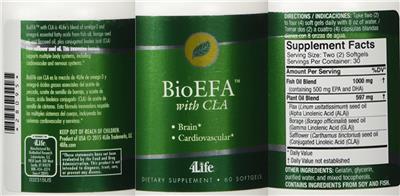
| Fish Oil BlendFish Oil Blend Note: containing | 1,000 mg | † |
| Eicosapentaenoic Acid | 500 mg | |
| Docosahexaenoic Acid | 500 mg | |
| Plant Oil Blend | 597 mg | † |
| Flax seed Oil (as Alpha-Linolenic Acid) | ||
| Borage seed Oil (as Gamma-Linolenic Acid) | ||
| Safflower seed oil (as Conjugated Linoleic Acid) |
Other ingredients: Gelatin, Glycerin, purified Water, Mixed Tocopherols
% Daily Values for: Adults and children 4 or more years of age.
Where this label comes from
An original label of the NIH's Dietary Supplement Label Database, entered there on 25 January 2020, shown here as it was entered. The NIH's record
General information
- Product name
- BioEFA with CLA
- Brand
- 4Life
- Barcode (UPC)
- Not printed
- Net contents
- 60 Softgel(s)
- Market status
- On market
- DSLD ID
- 211491
Classification
- Supplement form
- Softgel Capsule
- Product type
- Fat/Fatty Acid
- Claim types on the label
- Nutrient, All Other, Structure/Function
- Intended for
- Adult (18 - 50 Years)
Label statements
Formula: Contains: BioEFA with CLA is 4Life's blend of omega-3 and omega-6 essential fatty acids from fish oil, borage seed oil, and flaxseed oil, plus conjugated linoleic acid (CLA) from safflower seed oil. This innovative formula supports multiple body systems, including cardiovascular and nervous systems.
Precautions: Children: Keep out of reach of children.
FDA Statement of Identity: Dietary Supplement
Directions: Directions: Take two (2) to four (4) soft gels daily with 8 oz of water.
Precautions: Allergies: Contains Ingredients from soy and fish.
Formula: Contains: Contains Ingredients from soy and fish.
Brand information
Manufactured by: BioMedical Research Laboratories, LLC, Sandy, UT
A product of: 4Life
More labels from 4Life
Labels only: each label is shown as printed on the bottle, with no grades, rankings or advice. A label in this database is not an endorsement of the product. Read the label on the bottle you buy: makers change their formulas. Reverse Age Lab is not affiliated with, or endorsed by, the National Institutes of Health or its Office of Dietary Supplements. The original labels come from the NIH’s public-domain data; the labels since are read by us. Search the Dietary Supplement Label Database.