
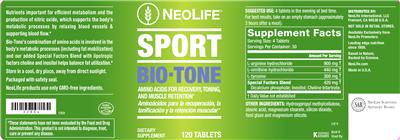
| L-Arginine Hydrochloride | 900 mg | † |
| L-Ornithine Hydrochloride | 440 mg | † |
| L-Tyrosine | 300 mg | † |
| Special Factors Blend | 420 mg | † |
| Dicalcium Phosphate | ||
| Inositol | ||
| Choline Bitartrate |
Other ingredients: Hydroxypropyl Methylcellulose, Stearic Acid, Magnesium Stearate, Silicon Dioxide, Food Glaze, Magnesium Silicate
% Daily Values for: Adults and children 4 or more years of age.
Where this label comes from
An original label of the NIH's Dietary Supplement Label Database, entered there on 25 January 2020, shown here as it was entered. The NIH's record
General information
- Product name
- Bio-Tone
- Brand
- NeoLife Sport
- Barcode (UPC)
- 3280s
- Net contents
- 120 Tablet(s)
- Market status
- Off market
- DSLD ID
- 212919
Classification
- Supplement form
- Tablet or Pill
- Product type
- Other Combinations
- Claim types on the label
- Nutrient, All Other, Structure/Function
- Intended for
- Adult (18 - 50 Years), Kosher
Label statements
Formula: Contains: Bio-Tone's combination of amino acids is involved in the body's metabolic processes (including fat mobilization) and our added Special Factors Blend with lipotropic factors choline and inositol helps balance fat utilization.
Storage: Store in a cool, dry place, away from direct sunlight.
Formulation: Does NOT Contain: NeoLife products use only GMO-free ingredients.
Formula: Contains: Amino acids for recovery, toning, and muscle retention
FDA Statement of Identity: Dietary Supplement
Directions: Suggested Use: 4 tablets in the evening at bed time. For best results, take on an empty stomach (approximately 3 hours after a meal).
Brand information
Distributed by: NeoLife International, LLC, Fremont, CA, U.S.A.
More labels from NeoLife Sport
Labels only: each label is shown as printed on the bottle, with no grades, rankings or advice. A label in this database is not an endorsement of the product. Read the label on the bottle you buy: makers change their formulas. Reverse Age Lab is not affiliated with, or endorsed by, the National Institutes of Health or its Office of Dietary Supplements. The original labels come from the NIH’s public-domain data; the labels since are read by us. Search the Dietary Supplement Label Database.