
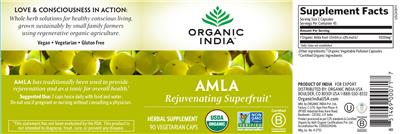
| organic Amlaorganic Amla PlantPart: fruit Genus: Emblica Species: officinalis Note: certified organic ingredients | 1,000 mg | † |
Other ingredients: organic Vegetable Pullulan Capsules
% Daily Values for: Adults and children 4 or more years of age.
Where this label comes from
An original label of the NIH's Dietary Supplement Label Database, entered there on 26 February 2020, shown here as it was entered. The NIH's record
General information
- Product name
- Amla
- Brand
- Organic India
- Barcode (UPC)
- 8 51469 00071 7
- Net contents
- 90 Vegetarian Cap(s)
- Market status
- Off market
- DSLD ID
- 213150
Classification
Label statements
Formulation: Does NOT Contain: Gluten free
Formula: Contains: Amla has traditionally been used to provide rejuvenation and as a tonic for overall health.
Directions: Suggested Use: 2 caps twice daily with food and water.
Precautions: Pregnant or Nursing or Prescription Medications: Do not use if pregnant or nursing without consulting a physician.
FDA Statement of Identity: Herbal Supplement
Formulation: Does NOT Contain: Non GMO Project Verified nongmoproject.org
Formulation: Does NOT Contain: Non GMO
Brand information
Mfd. by: Organic India Pvt. Ltd., Barabanki, U.P., India
Distributed by: Organic India USA, Boulder, CO, USA
More labels from Organic India
Labels only: each label is shown as printed on the bottle, with no grades, rankings or advice. A label in this database is not an endorsement of the product. Read the label on the bottle you buy: makers change their formulas. Reverse Age Lab is not affiliated with, or endorsed by, the National Institutes of Health or its Office of Dietary Supplements. The original labels come from the NIH’s public-domain data; the labels since are read by us. Search the Dietary Supplement Label Database.