
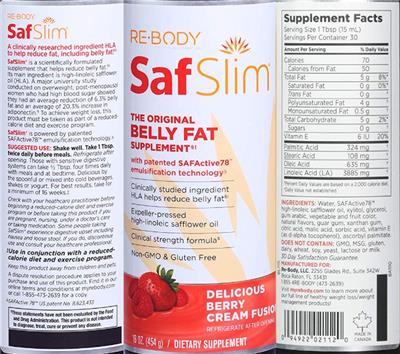
| Calories | 70 | |
| Calories from Fat | 50 | |
| Total Fat | 5 g | 8% |
| Saturated Fat | 0 g | 0% |
| Trans Fat | 0 g | † |
| Polyunsaturated Fat | 4 g | † |
| Monounsaturated Fat | 0.5 g | † |
| Total Carbohydrates | 5 g | 2% |
| Sugar | 0 g | † |
| Vitamin E | 6 IU | 20% |
| Palmitic Acid | 324 mg | † |
| Stearic Acid | 108 mg | † |
| Oleic Acid | 635 mg | † |
| Linoleic Acid | 3,885 mg | † |
Other ingredients: Water, SAFActive78 high-Linoleic Safflower Oil, Xylitol, Glycerol, Gum Arabic, Vegetable and Fruit, Natural Flavors, Guar Gum, Xanthan Gum, Citric Acid, Malic Acid, Sorbic Acid, Vitamin E, Ascorbyl Palmitate
% Daily Values for: Adults and children 4 or more years of age.
Where this label comes from
An original label of the NIH's Dietary Supplement Label Database, entered there on 26 February 2020, shown here as it was entered. The NIH's record
General information
- Product name
- SafSlim Delicious Berry Cream Fusion
- Brand
- Re-Body
- Barcode (UPC)
- 0 94922 02112 0
- Net contents
- 16 oz; 454 Gram(s)
- Market status
- Off market
- DSLD ID
- 213594
Classification
- Supplement form
- Liquid
- Product type
- Fat/Fatty Acid
- Claim types on the label
- Nutrient, All Other, Structure/Function
- Intended for
- Adult (18 - 50 Years), Gluten Free, Dairy Free
Label statements
Formula: Contains: A clinically researched ingredient HLA to help reduce fat, including belly fat! SafSlim is a scientifically formulated supplement that helps reduce belly fat. Its main ingredient is high-linoleic safflower oil (HLA).
Directions: A major university study conducted on overweight, post-menopausal women who had high blood sugar showed they had an average reduction of 6.3% belly fat and an average of 20.3% increase in adiponectin. To achieve weight loss, this product must be taken as part of a reduced-calorie diet and exercise program.
Directions: Suggested Use: Shake well. Take 1 Tbsp. twice daily before meals.
Storage: Refrigerate after opening.
Directions: Those with sensitive digestive systems can take 3/2 Tbsp. four times daily with meals and at bedtime. Delicious by the spoonful or mixed into cold beverages, shakes or yogurt. For best results, take for a minimum of 16 weeks.
Precautions: Pregnant or Nursing or Prescription Medications: Check with your healthcare practitioner before beginning a reduced-calorie diet and exercise program or before taking this product if you are pregnant, nursing, under a doctor's care or taking medication.
Precautions: All Other: Some people taking SafSlim experience digestive upset including nausea and loose stool. If you do, discontinue use and consult your healthcare professional.
Directions: Use in conjunction with a reduced-calorie diet and exercise program.
Precautions: Children: Keep this product away from children and pets.
FDA Statement of Identity: The original belly fat supplement
Formula: Contains: With patented SAFActive78 emulsification technology Clinically studied ingredient HLA helps reduce belly fat Expeller-pressed high-linoleic safflower oil
Formulation: Does NOT Contain: Non-GMO & Gluten free
Storage: Refrigerate after opening
FDA Statement of Identity: Dietary Supplement
Formulation: Does NOT Contain: Does Not Contain: GMO, MSG, gluten, dairy, wheat, soy, yeast, lactose or milk.
Precautions: All Other: Keep this product away from children and pets.
Brand information
Manufactured for: Re-Body, LLC, Boca Raton, FL
More labels from Re-Body
Labels only: each label is shown as printed on the bottle, with no grades, rankings or advice. A label in this database is not an endorsement of the product. Read the label on the bottle you buy: makers change their formulas. Reverse Age Lab is not affiliated with, or endorsed by, the National Institutes of Health or its Office of Dietary Supplements. The original labels come from the NIH’s public-domain data; the labels since are read by us. Search the Dietary Supplement Label Database.