
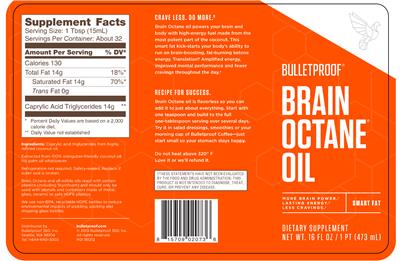
| Calories | 130 | |
| Total Fat | 14 g | 18% |
| Saturated Fat | 14 g | 70% |
| Trans Fat | 0 g | |
| Caprylic Acid Triglycerides | 14 g | † |
Other ingredients: Caprylic Acid Triglycerides
% Daily Values for: Adults and children 4 or more years of age.
Where this label comes from
An original label of the NIH's Dietary Supplement Label Database, entered there on 26 February 2020, shown here as it was entered. The NIH's record
General information
- Product name
- Brain Octane Oil
- Brand
- Bulletproof
- Barcode (UPC)
- 8 15709 02073 6
- Net contents
- 16 fl. Oz.; 1 Pint(s); 473 mL
- Market status
- On market
- DSLD ID
- 213899
Classification
- Supplement form
- Liquid
- Product type
- Fat/Fatty Acid
- Claim types on the label
- Nutrient, All Other, Structure/Function
- Intended for
- Adult (18 - 50 Years)
Label statements
Formulation: Does NOT Contain: No palm oil whatsoever.
Storage: Refrigeration not required.
Precautions: All Other: Safety-sealed. Replace if outer seal is broken.
Precautions: All Other: Brain Octane and all edible oils react with certain plastics (including Styrofoam) and should only be used with utensils and containers made of metal, glass, ceramic or safe HDPE plastics.
Directions: Recipe for success. Brain Octane oil is flavorless so you can add it to just about everything. Start with one teaspoon and build to the full one-tablespoon serving over several days. Try it in salad dressings, smoothies or your morning cup of Bulletproof Coffee-just start small so your stomach stays happy.
Precautions: All Other: Do not heat about 320 degrees F
FDA Statement of Identity: Dietary Supplement
Brand information
Distrubuted by: Bullet Proof 360 Inc., Seattle, WA
More labels from Bulletproof
Labels only: each label is shown as printed on the bottle, with no grades, rankings or advice. A label in this database is not an endorsement of the product. Read the label on the bottle you buy: makers change their formulas. Reverse Age Lab is not affiliated with, or endorsed by, the National Institutes of Health or its Office of Dietary Supplements. The original labels come from the NIH’s public-domain data; the labels since are read by us. Search the Dietary Supplement Label Database.