
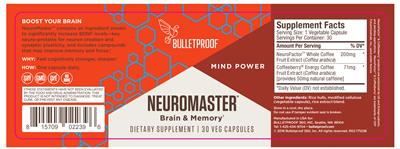
| NeuroFactor whole Coffee fruit extract | 200 mg | † |
| Coffeeberry Energy Coffee fruit extractCoffeeberry Energy Coffee fruit extract PlantPart: fruit Genus: Coffea Species: arabica Note: provides | 71 mg | † |
| natural Caffeine | 50 mg |
Other ingredients: Rice, Modified Cellulose, Rice Extract Blend
% Daily Values for: Adults and children 4 or more years of age.
Where this label comes from
An original label of the NIH's Dietary Supplement Label Database, entered there on 26 February 2020, shown here as it was entered. The NIH's record
General information
- Product name
- Neuromaster
- Brand
- Bulletproof
- Barcode (UPC)
- 8 15709 02239 6
- Net contents
- 30 Veg Capsule(s)
- Market status
- On market
- DSLD ID
- 213932
Classification
Label statements
Formula: Contains: NeuroMaster contains an ingredient shown to significantly increase BDNF levels-key neuro-proteins for neuron creation and synaptic plasticity, and includes compounds that may improve memory and focus.
Directions: How: One capsule daily.
FDA Statement of Identity: Dietary Supplement
Storage: Store in a cool, dry place.
Precautions: All Other: Do not use if tamper evident seal is broken.
Brand information
Manufactured in USA for: Bullet Proof 360 Inc., Seattle, WA
More labels from Bulletproof
Labels only: each label is shown as printed on the bottle, with no grades, rankings or advice. A label in this database is not an endorsement of the product. Read the label on the bottle you buy: makers change their formulas. Reverse Age Lab is not affiliated with, or endorsed by, the National Institutes of Health or its Office of Dietary Supplements. The original labels come from the NIH’s public-domain data; the labels since are read by us. Search the Dietary Supplement Label Database.