
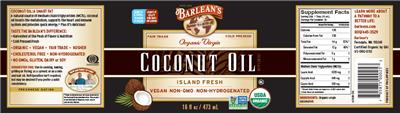
| Calories | 130 | |
| Calories from Fat | 130 | |
| Total Fat | 14 g | 22% |
| Saturated Fat | 12 g | 60% |
| Polyunsaturated Fat | 0 g | † |
| Monounsaturated Fat | 1 g | † |
| Medium Chain Triglycerides | ||
| Lauric Acid | 6,220 mg | † |
| Caprylic Acid | 640 mg | † |
| Capric Acid | 550 mg | † |
Other ingredients: organic virgin Coconut Oil
% Daily Values for: Adults and children 4 or more years of age.
Where this label comes from
An original label of the NIH's Dietary Supplement Label Database, entered there on 24 March 2020, shown here as it was entered. The NIH's record
General information
- Product name
- Organic Virgin Coconut Oil
- Brand
- Barlean's
- Barcode (UPC)
- 7 05875 00025 3
- Net contents
- 16 fl. Oz.; 743 mL
- Market status
- Off market
- DSLD ID
- 215516
Classification
- Supplement form
- Liquid
- Product type
- Fat/Fatty Acid
- Claim types on the label
- Nutrient, Structure/Function
- Intended for
- Vegan, Vegetarian, Adult (18 - 50 Years), Kosher, Organic, Gluten Free, Dairy Free
Label statements
Formula: Contains: Coconut Oil: A smart fat A natural source of medium chain triglycerides (MCTs), coconut oil boosts the metabolism, supports the heart and immune system and provides quick energy. Plus it's delicious.
Formulation: Does NOT Contain: Cholesterol Free No GMO's, Gluten, Dairy or Soy
Directions: Suggested use: Use in cooking, baking, grilling or frying, as a spread, or as a skin and hair oil. Refrigeration isn't required, but may be desired if you prefer a solid consistency.
FDA Statement of Identity: Coconut Oil Supplement
Formulation: Does NOT Contain: Non-GMO
Formulation: Does NOT Contain: Non-Hydrogentated
Brand information
Manufacturer: Barlean's, Ferndale, WA
More labels from Barlean's
Labels only: each label is shown as printed on the bottle, with no grades, rankings or advice. A label in this database is not an endorsement of the product. Read the label on the bottle you buy: makers change their formulas. Reverse Age Lab is not affiliated with, or endorsed by, the National Institutes of Health or its Office of Dietary Supplements. The original labels come from the NIH’s public-domain data; the labels since are read by us. Search the Dietary Supplement Label Database.