
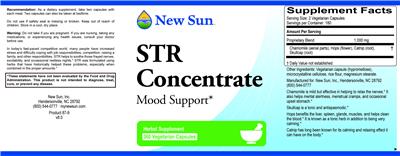
| Proprietary Blend | 1,000 mg | |
| Chamomile | † | |
| Hops | † | |
| Catnip | † | |
| Skullcap | † |
Other ingredients: Vegetarian Capsule, Microcrystalline Cellulose, Rice Flour, Magnesium Stearate
% Daily Values for: Adults and children 4 or more years of age.
Where this label comes from
An original label of the NIH's Dietary Supplement Label Database, entered there on 23 April 2020, shown here as it was entered. The NIH's record
General information
- Product name
- STR Concentrate
- Brand
- New Sun
- Barcode (UPC)
- 87-9
- Net contents
- 360 Vegetarian Capsule(s)
- Market status
- On market
- DSLD ID
- 217852
Classification
Label statements
Directions: Recommendation: As a dietary supplement, take two capsules with each meal. Two capsules can also be taken at bedtime.
Precautions: All Other: Do not use if safety seal is missing or broken.
Precautions: Children: Keep out of reach of children.
Storage: Store in a cool, dry place.
Precautions: Pregnant or Nursing or Prescription Medications: Warning: Do not take if you are pregnant. If you are nursing, taking any medications, or experiencing any health issues, consult your doctor before use.
FDA Statement of Identity: Herbal Supplement
Formula: Contains: Chamomile is mild but effective in helping to relax the nerves. It also helps mental alertness, menstrual cramps, and occasional upset stomach. Skullcap is a tonic and antispasmodic. Hops benefits the liver, spleen, glands, muscles, and helps clean the blood. It is known as a tonic herb in addition to being very calming. Catnip has been known for its calming and relaxing effect it can have on the body.
Brand information
Manufactured for: New Sun, Inc., Hendersonville, NC
More labels from New Sun
Labels only: each label is shown as printed on the bottle, with no grades, rankings or advice. A label in this database is not an endorsement of the product. Read the label on the bottle you buy: makers change their formulas. Reverse Age Lab is not affiliated with, or endorsed by, the National Institutes of Health or its Office of Dietary Supplements. The original labels come from the NIH’s public-domain data; the labels since are read by us. Search the Dietary Supplement Label Database.