
| Calories | 120 | |
| Total Fat | 14 g | 18% |
| Saturated Fat | 1.5 g | 8% |
| Polyunsaturated Fat | 9 g | † |
| Monounsaturated Fat | 2.5 g | † |
| Alpha-Linolenic AcidOmega-3 ALA (Alt. Name: Alpha-Linolenic Acid) | 6 g | † |
| Linoleic AcidOmega-6 LA (Alt. Name: Linolenic Acid) | 3 g | † |
| Oleic AcidOmega-9 OA (Alt. Name: Oleic Acid) | 2.5 g | † |
Other ingredients: organic Flax seed Oil, organic Sunflower seed Oil, organic Sesame seed Oil, Organic Coconut Oil, organic Evening Primrose seed Oil, organic Soy Lecithin, organic Rice Bran oil, organic Oat Bran oil, Mixed Tocopherols
% Daily Values for: Adults and children 4 or more years of age.
Where this label comes from
An original label of the NIH's Dietary Supplement Label Database, entered there on 23 April 2020, shown here as it was entered. The NIH's record
General information
- Product name
- Udo's Oil 3-6-9 Blend
- Brand
- Flora
- Barcode (UPC)
- 0 61998 67980 7
- Net contents
- 8.5 fl. Oz.; 250 mL
- Market status
- On market
- DSLD ID
- 218290
Classification
- Supplement form
- Liquid
- Product type
- Fat/Fatty Acid
- Claim types on the label
- Nutrient, All Other
- Intended for
- Vegan, Vegetarian, Adult (18 - 50 Years), Kosher, Organic, Gluten Free
Label statements
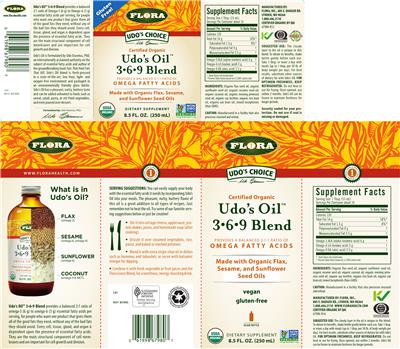
Formula: Contains: Udo's Oil High Lignan 3-6-9 Blend provides a balanced 2:1 ratio of omega-3 (6 g) to omega-6 (3 g) essential fatty acids per serving, for people who want one product that gives them all of the good fats they need, without any of the bad fats they should avoid.
Directions: Udo's Oil has a pleasant, nutty, buttery taste and can be added unheated to foods such as cereal, salad, pasta, or stir-fried vegetables, and even poured over dessert.
Formulation: Does NOT Contain: Gluten free
Formula: Contains: Made with organic flax, sesame, and sunflower seed oils
FDA Statement of Identity: Dietary Supplement
Formulation: Does NOT Contain: Non GMO Project Verified nongmoproject.org
Precautions: Allergies: Caution: Manufactured in a facility that also processes mustard and wheat.
Formula: Contains: Plant based Omega-3 Fish Free
Directions: Suggested use: The cloudy layer in the oil is unique to this blend. To obtain its benefits, shake bottle gently before each use. Take 1 tbsp. or more a day with meals (up to 1 tbsp. per 50 lb. of body weight per day). For best results, substitute other sources of dietary fat with Udo's Oil.
Storage: For optimum freshness, keep refrigerated.
Precautions: All Other: Do not heat or use for frying.
Directions: Once opened, use within 2 months.
Storage: Udo's Oil can be frozen to maintain freshness for longer periods.
Precautions: All Other: Security sealed for your protection. Do not use if seal is missing or damaged.
Formula: Contains: What is in Udo's Oil? Flax (omega-3) Sesame (omega-6, omega-9) Sunflower (omega-6) Coconut (omega-9 & MCT)
Directions: Serving Suggestions: You can easily supply your body with the essential fatty acids it needs by incorporating Udo's Oil High Lignan 3-6-9 Blend into your meals. The pleasant nutty, buttery flavor of this oil is a great addition to all types of recipes. Just remember not to heat the oil. Try some of our favorite serving suggestions below or just be creative. Stir into cottage cheese, applesauce, protein shakes, juices, and homemade soup (after cooking). Drizzle it over steamed vegetables, rice, pasta, and baked or mashed potatoes. Blend it with extra virgin olive oil in dishes such as hummus and tabouleh, or serve with balsamic vinegar for dipping. Combine it with fresh vegetable or fruit juices and the Flora Green Blend, for a nutritious, energy-boosting drink.
Brand information
Manufactured by: Flora, Inc., Lynden, WA
More labels from Flora
Labels only: each label is shown as printed on the bottle, with no grades, rankings or advice. A label in this database is not an endorsement of the product. Read the label on the bottle you buy: makers change their formulas. Reverse Age Lab is not affiliated with, or endorsed by, the National Institutes of Health or its Office of Dietary Supplements. The original labels come from the NIH’s public-domain data; the labels since are read by us. Search the Dietary Supplement Label Database.