
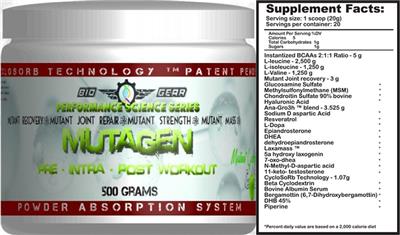
Supplement Facts
Serving Size 20 Gram(s)
Servings Per Container 20
Amount Per Serving% Daily Value
| Calories | 5 | |
| Total Carbohydrates | 1 g | |
| Sugar | 1 g | |
| Instantized BCAAsInstantized BCAAs Note: 2:1:1 | 5 g | |
| L-Leucine | 2,500 g | |
| L-Isoleucine | 1,250 g | |
| L-Valine | 1,250 g | |
| Mutant Joint Recovery | 3 g | |
| Glucosamine Sulfate | ||
| Methylsulfonylmethane | ||
| Chondroitin Sulfate (as Bovine)Chondroitin Sulfate (Form: 90% Bovine) | ||
| Hyaluronic Acid | ||
| Ana-Gro3h Blend | 3.525 g | |
| Sodium D-Aspartic Acid | ||
| Resveratrol | ||
| L-Dopa | ||
| Epiandrosterone | ||
| Dehydroepiandrosterone | ||
| Dehydroepiandrosterone | ||
| Laxamass | ||
| 5a Hydroxy Laxogenin | ||
| 7-oxo-DHEA | ||
| N-Methyl-D-Aspartic Acid | ||
| 11-Keto- Testosterone | ||
| CycloSoRb Technology | 1.07 g | |
| Beta Cyclodextrin | ||
| Bovine Albumin Serum | ||
| Bergamottin (as 6,7-Dihydroxybergamottin) | ||
| DHBDHB Note: 45% | ||
| Piperine |
* Percent Daily Value are based on a 2,000 calorie diet.
% Daily Values for: Adults and children 4 or more years of age.
Where this label comes from
An original label of the NIH's Dietary Supplement Label Database, entered there on 23 April 2020, shown here as it was entered. The NIH's record
General information
- Product name
- Mutagen
- Brand
- Bio Gear Performance Science Series
- Barcode (UPC)
- Not printed
- Net contents
- 500 Gram(s)
- Market status
- Off market
- DSLD ID
- 218714
Classification
- Supplement form
- Powder
- Product type
- Other Combinations
- Claim types on the label
- Structure/Function
- Intended for
- Adult (18 - 50 Years)
Brand information
Not Present: BioGear Supplements
More labels from Bio Gear Performance Science Series
Labels only: each label is shown as printed on the bottle, with no grades, rankings or advice. A label in this database is not an endorsement of the product. Read the label on the bottle you buy: makers change their formulas. Reverse Age Lab is not affiliated with, or endorsed by, the National Institutes of Health or its Office of Dietary Supplements. The original labels come from the NIH’s public-domain data; the labels since are read by us. Search the Dietary Supplement Label Database.