
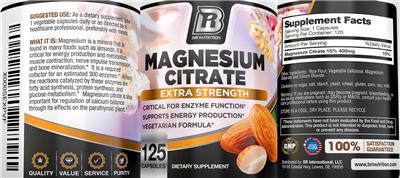
| Magnesium CitrateMagnesium Citrate Note: 15% | 400 mg | 15% |
Other ingredients: Rice Flour, Vegetable Cellulose, Magnesium Stearate, Silicon Dioxide
% Daily Values for: Adults and children 4 or more years of age.
Where this label comes from
An original label of the NIH's Dietary Supplement Label Database, entered there on 23 April 2020, shown here as it was entered. The NIH's record
General information
- Product name
- Magnesium Citrate
- Brand
- BRI Nutrition
- Barcode (UPC)
- X000SEXPVF
- Net contents
- 125 Capsule(s)
- Market status
- On market
- DSLD ID
- 219124
Classification
Label statements
Directions: Suggested Use: As a dietary supplement, take 1 vegetable capsules daily or as directed by a healthcare professional.
Formula: Contains: What it is: Magnesium is a mineral that is found in many foods such as almonds, it is critical for energy production and metabolism, muscle contraction, nerve impulse transmission, and bone mineralization. It is a required cofactor for an estimated 300 enzymes. Among their reactions catalyzed by these enzymes are fatty acids synthesis, protein synthesis, and glucose metabolism. Magnesium citrate is also important for regulation of calcium balance through its effects on the parathyroid gland.
FDA Statement of Identity: Dietary Supplement
Formulation: Does NOT Contain: Contains no: Sugar, salt, starch, yeast, wheat, gluten, corn, soy, milk.
Precautions: Pregnant or Nursing or Prescription Medications: Warning: If you are pregnant, may become pregnant, breastfeeding, or are taking medications such as SSRIs or MAOIs, consult your health care professional before using this product.
Storage: Store in a cool, dry place.
Brand information
Distributed by: BR International, LLC, Lewes, DE, 19958
More labels from BRI Nutrition
Labels only: each label is shown as printed on the bottle, with no grades, rankings or advice. A label in this database is not an endorsement of the product. Read the label on the bottle you buy: makers change their formulas. Reverse Age Lab is not affiliated with, or endorsed by, the National Institutes of Health or its Office of Dietary Supplements. The original labels come from the NIH’s public-domain data; the labels since are read by us. Search the Dietary Supplement Label Database.