
Ultimate PC+ Phosphatidyl Choline Liver & Brain Granules
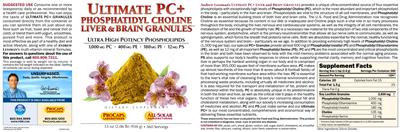
| Calories | 20 | |
| Calories from Fat | 15 | |
| Total Fat | 1.5 g | 2% |
| Trans Fat | 0 g | |
| Soy Lecithin Granules | 2,600 mg | † |
| Phosphatidyl Choline | 1,000 mg | |
| Phosphatidyl Ethanolamine | 400 mg | |
| Phosphatidyl Inositol | 180 mg | |
| Choline | 135 mg | |
| Phosphatidyl Serine | 25 mg |
Other ingredients: Silicon Dioxide
% Daily Values for: Adults and children 4 or more years of age.
Where this label comes from
An original label of the NIH's Dietary Supplement Label Database, entered there on 22 May 2020, shown here as it was entered. The NIH's record
General information
- Product name
- Ultimate PC+ Phosphatidyl Choline Liver & Brain Granules
- Brand
- ProCaps Laboratories
- Barcode (UPC)
- Not printed
- Net contents
- 33 Ounce(s); 2.06 Pound(s); 936 Gram(s)
- Market status
- Off market
- DSLD ID
- 220231
Classification
- Supplement form
- Powder
- Product type
- Fat/Fatty Acid
- Claim types on the label
- Nutrient, All Other, Structure/Function
- Intended for
- Adult (18 - 50 Years), Gluten Free, Dairy Free, Sugar Free
Label statements
Directions: Suggested Use Consume one or more teaspoon(s) daily or as recommended by a health care professional. You can enjoy the taste of Ultimate PC+ Granules consumed directly from the container or you can sprinkle them on just about any food such as fruit, toast and cereal (hot or cold); or blend them with yogurt, smoothies, pureed fruit and more. This product is most effective as part of a healthy diet and active lifestyle, along with one of Andrew Lessman's multi-vitamin-mineral formulas. For answers to questions about the use of this product, call 800.808.7311.
Formula: Contains: Ultra high potency phospholipids 1,000 mg PC 400 mg PE 180 mg PI 12 mg PS
FDA Statement of Identity: Dietary Supplement
Formula: Contains: Andrew Lessman’s Ultimate PC+ Phosphatidyl Choline Liver & Brain Granules provides a unique ultra-concentrated source of four essential phospholipids with exceptionally high levels of phosphatidyl choline (PC), which is the most abundant and important phospholipid in the body – particularly in the liver and brain.
Formula: Contains: In addition to providing extremely high levels of phosphatidyl choline (1,000 mg per tsp), our special PC granules also provide 580 mg of phosphatidyl inositol (PI) and phosphatidyl ethanolamine (PE), as well as 12 mg of all-important phosphatidyl serine (PS). PC and PS are the most concentrated and critical phospholipids in the brain and both have been observed to help with the mild memory problems associated with the normal aging process. PS also supports our body's healthy response to stress while supporting mental clarity, memory and cognitive function. The liver is perhaps the hardest working organ in our body and is comprised of more than 355,000 square feet of membrane surface area. PC makes up almost two-thirds of the more than 8 acres (about 8 football fields) of that hard-working membrane surface area within the liver.
Formula: Contains: Given our concerns about fat and cholesterol metabolism, along with our society's increasing consumption of medicines and alcohol, PC and PS just make sense and our new Ultimate PC+ Phosphatidyl Choline Liver & Brain Granules is our most concentrated, comprehensive and economical way of delivering these essential nutrients.
Formulation: Does NOT Contain: Contains no milk, yeast, corn, wheat, gluten, sodium, salt, sugar, starch, cholesterol, oil, emulsifier, wax, binder, filler, lubricant, coating, diluent, color, flavor, sweetener or preservative.
Brand information
Manufacturer: ProCaps Laboratories, Henderson, NV
More labels from ProCaps Laboratories
Labels only: each label is shown as printed on the bottle, with no grades, rankings or advice. A label in this database is not an endorsement of the product. Read the label on the bottle you buy: makers change their formulas. Reverse Age Lab is not affiliated with, or endorsed by, the National Institutes of Health or its Office of Dietary Supplements. The original labels come from the NIH’s public-domain data; the labels since are read by us. Search the Dietary Supplement Label Database.