
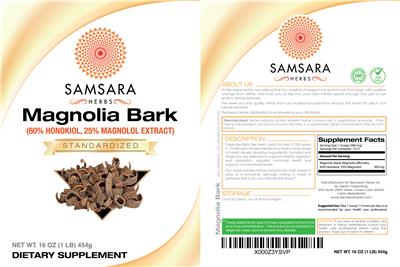
| Magnolia (as Honokiol, Magnolol)Magnolia (Form: 60% Honokiol, 25% Magnolol) PlantPart: bark Genus: Magnolia Species: officinalis | 300 mg |
% Daily Values for: Adults and children 4 or more years of age.
Where this label comes from
An original label of the NIH's Dietary Supplement Label Database, entered there on 22 May 2020, shown here as it was entered. The NIH's record
General information
- Product name
- Magnolia Bark
- Brand
- Samsara Herbs
- Barcode (UPC)
- X000Z3YSVP
- Net contents
- 16 Ounce(s); 454 Gram(s); 1 Pound(s)
- Market status
- On market
- DSLD ID
- 220780
Classification
Label statements
Formula: Contains: Magnolia Bark (60% Honokiol, 25% Magnolol extract)
FDA Statement of Identity: Dietary Supplement
Formula: Contains: Description Magnolia Bark has been used for over 2,000 years in Traditional Chinese Medicine to treat a wide range of hearth issues. Its active ingredients, Honokiol and Magnolol, are believed to support healthy digestion and respiration, regulate hormonal health and support normal stress levels.
Directions: Our water soluble herbal extracts are best mixed in juice or a smoothie, although mixing in water is perfectly fine if you can tolerate the taste.
Storage: Storage Cool dry place, out of direct sunlight.
Directions: Suggested Use: Take 1 Scoop 1-3 times per day or as recommended by your health care professional.
Precautions: Pregnant or Nursing or Prescription Medications: Caution: If you have a medical condition, are pregnant or taking medications, consult your hearth care professional before using this product.
Precautions: Children: Keep out of reach of children.
Brand information
Manufactured by: Aspen Copacking, Lindon, Utah
Manufactured for: Samsara Herbs Inc.
More labels from Samsara Herbs
Labels only: each label is shown as printed on the bottle, with no grades, rankings or advice. A label in this database is not an endorsement of the product. Read the label on the bottle you buy: makers change their formulas. Reverse Age Lab is not affiliated with, or endorsed by, the National Institutes of Health or its Office of Dietary Supplements. The original labels come from the NIH’s public-domain data; the labels since are read by us. Search the Dietary Supplement Label Database.