
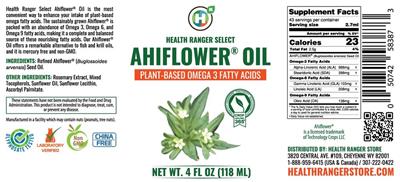
| Calories | 23 | |
| Total Fat | 2.5 g | 4% |
| Ahiflower (Buglossoides arvensis) seed oil | ||
| Omega-3 Fatty Acids | ||
| Alpha-Linolenic Acid | 988 mg | † |
| Stearidonic Acid | 398 mg | † |
| Omega-6 Fatty Acids | ||
| Gamma-Linolenic Acid | 103 mg | † |
| Linoleic Acid | 208 mg | † |
| Omega-9 Fatty Acids | ||
| Oleic Acid | 138 mg | † |
Other ingredients: Ingredients
% Daily Values for: Adults and children 4 or more years of age.
Where this label comes from
An original label of the NIH's Dietary Supplement Label Database, entered there on 22 May 2020, shown here as it was entered. The NIH's record
General information
- Product name
- Ahiflower Oil
- Brand
- Health Ranger Select
- Barcode (UPC)
- 0 50742 58387 3
- Net contents
- 4 Fluid Ounce(s); 118 mL
- Market status
- On market
- DSLD ID
- 221376
Classification
Label statements
Formula: Contains: Health Ranger Select Ahiflower Oil is the most convenient way to enhance your intake of plant-based omega fatty acids. The sustainably grown Ahiflower is packed with an abundance of Omega 3, Omega 6, and Omega 9 fatty acids, making it a complete and balanced source of these nourishing fatty acids. Our Ahiflower Oil offers a remarkable alternative to fish and krill oils, and it is mercury free and non-GMO.
Formulation: Does NOT Contain: Our Ahiflower Oil offers a remarkable alternative to fish and krill oils, and it is mercury free and non-GMO.
Precautions: Allergies: Manufactured in a facility which may contain nuts (peanuts, tree nuts).
Formulation: Does NOT Contain: Non GMO
Formula: Contains: Plant-based Omega 3 fatty acids
Brand information
Distributed by: Health Ranger Store, Cheyenne, WY
More labels from Health Ranger Select
Labels only: each label is shown as printed on the bottle, with no grades, rankings or advice. A label in this database is not an endorsement of the product. Read the label on the bottle you buy: makers change their formulas. Reverse Age Lab is not affiliated with, or endorsed by, the National Institutes of Health or its Office of Dietary Supplements. The original labels come from the NIH’s public-domain data; the labels since are read by us. Search the Dietary Supplement Label Database.